
I’ve played a lot of Analgesic Productions’ stuff over the years. I actually played their debut game, Anodyne, back in high school. I’ve played almost everything the duo of Melos Han-Tani and Marina Kittaka put out for this site, and in fact, I decided to shove everything in a category for easy reading. Today, we’re looking at their latest game, Angeline Era! I previously took a short look at it last year from Steam Next Fest, but now we’re looking at the full thing!
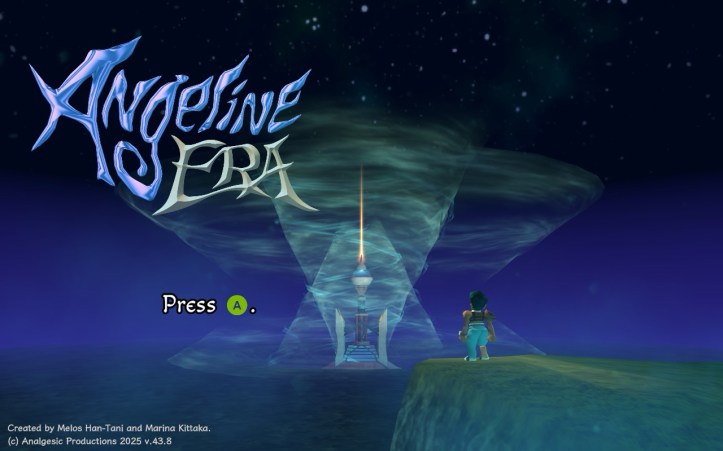
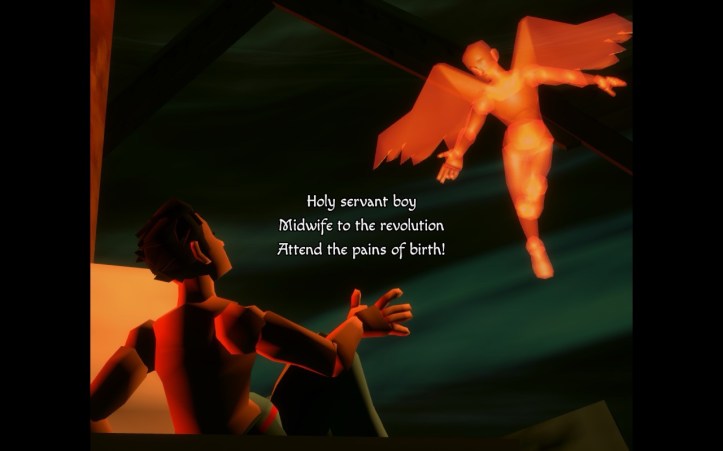
2025’s Angeline Era tells the story of a young man named Tets arriving at the land of Era, on a presumed mission ordained by God. In a world haunted by fae and angels, Tets seeks out the bicones to enable him to reach the Throne that the angels crashed on Earth. And perhaps he’ll craft a new understanding of himself and the world on the way…
“How will Tets do that?” you may ask, expecting typical action-adventure fare close to Anodyne. Maybe a platforming venture like Even the Ocean and Sephonie.
There’s a mix of both, but it’s not ordinary action – it’s bumpslash action.
Bump into something and Tets will slash it or interact with it. You gotta be brave, you gotta run Tets into an enemy’s weak point to hurt them. Just idlying about and running away from your problems won’t fix them, will it, Tets?
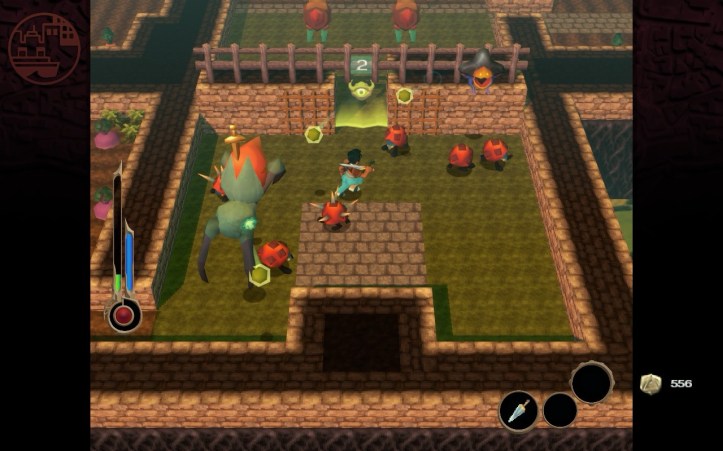
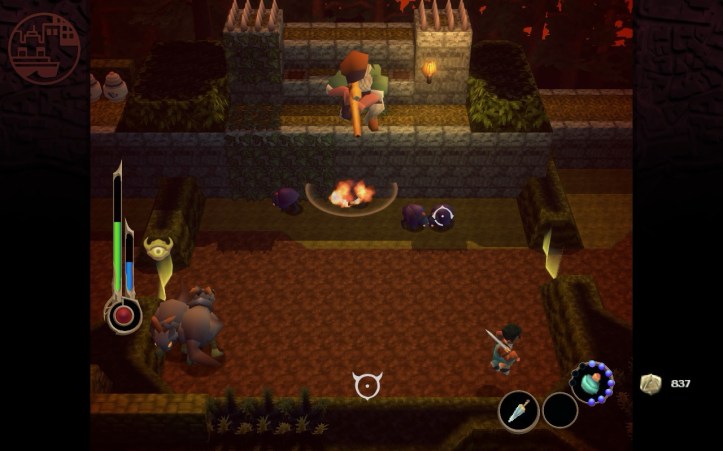
“Ah, that seems pretty easy,” you may arrogantly think. It starts out easy enough. Then the enemy variety starts growing. You start to have enemies that shoot at you, and Tets can’t do anything about bullets. Those basic mantis-like enemies will have later variants that shoot at you and aggressively keep their distance. Some enemies will carry shields or blades at their sides, forcing you to navigate around to their weak point or wait for an opening. Meanwhile, they’re distracting you from enemies that actively gun for you – more literally in the case of levels with snipers shooting at you when you stand still for too long.
It’s not all bump-slashing action, though. You can get some items to expand Tets’ killing repetorie, but most importantly, he gets a gun. “Ah, this game is easy now-” You smug fool. Tets only operates on shmup rules, he only shoots straight up. It thankfully ignores elevation, so you can get revengeance on jerks like those snipers. But you can’t freely shoot, you gotta refill the gun by bumping into jerks. Some levels will have either respawning enemies or an invincible guy that will help keep the gun full, ensuring its always in play. The gun isn’t something to fully rely on, but it’s a nice companion to the game’s normal action.
There’s also some active use artifacts. There’s handy explosives with the balancing factor that Tets isn’t immune to them. The other ones are whatever, but I wish I wasn’t whatever about the flute, which summons neutral enemies that can hurt everything. It can only be used in a few areas, which is a shame because I think summoning an enemy to help and hurt you would be fun to use throughout the game. I’d love to summon a hater to distract my opps.
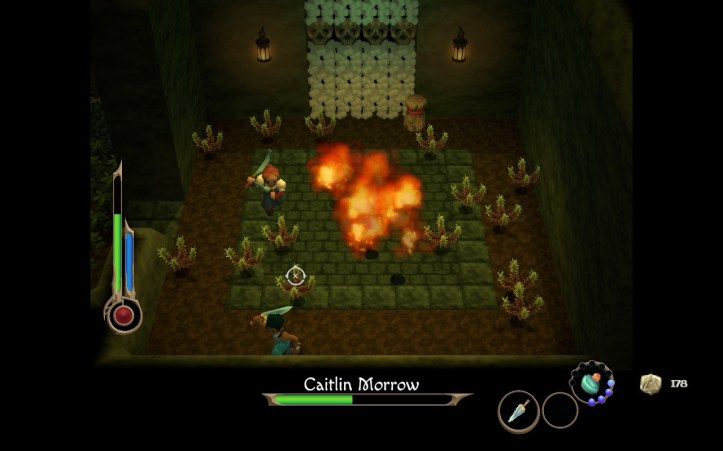
Angeline Era has a strong enemy variety with various formations to make most levels a fresh challenge. Though, the strongest showings are obviously the bosses. They all feel distinct from each other and provide fresh new challenges. The simple swarm of fish at the beginning of the game unleashing a patterned bullet hell contrasts pretty strongly with a teleporting jerk that you have to bait into taking damage from a third-party to weaken them while they’re unleashing their own brand of bullet hell; though again, it makes me wish the flute could be used anywhere.
If things get too tough, you can buy a little snack and eat it before starting a level or boss to get some extra health. If that’s not enough though, you can freely turn down the difficulty. I played on normal difficulty most of the time, but I turned things down when levels were too busy and I felt overstimulated (level with the bouncing orbs that made rings of energy everywhere, do not interact). Generally, Angeline Era tries to be a welcoming experience.
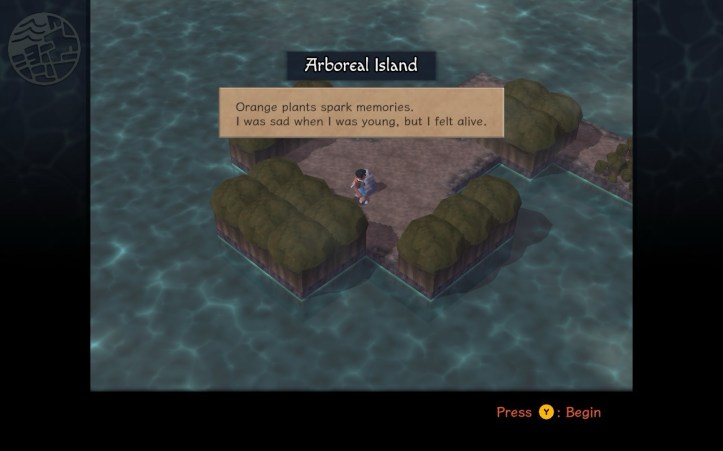
Outside of fighting, Angeline Era is a game about discovery. On the world map, searching at odd spots gives you a little minigame that ends with Tets arriving at a new level. What’s interesting about this is that like a quarter of these discoveries don’t lead you anywhere important gameplay wise. No scales that’d open new paths forward and level Tets up, no important rewards, just a little trip off the beaten path. They’ll still make for interesting divergences, like this funny waterfall cave with bats worshipping a statue.
But you know what? That’s great. Maybe I’m biased as someone that loves shoving flavor text in their stuff, but it’s nice that you can discover interesting but unimportant stuff. Besides, isn’t that true for the art of discovery? Maybe you’re at a thrift store and you can’t find something you came there in hopes of finding. However, maybe something does catch your eye that you didn’t expect and you grab that instead. That’s how half of my DVD collection was born. That’s what discovery can feel like in Angeline Era.
Now, you might think, what do I think about the story?
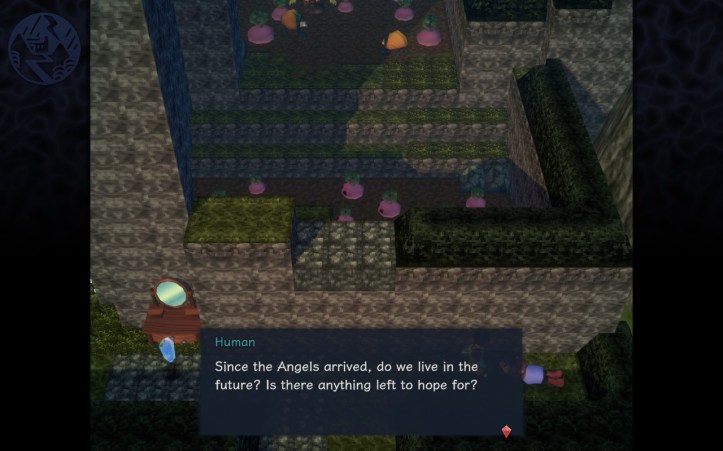
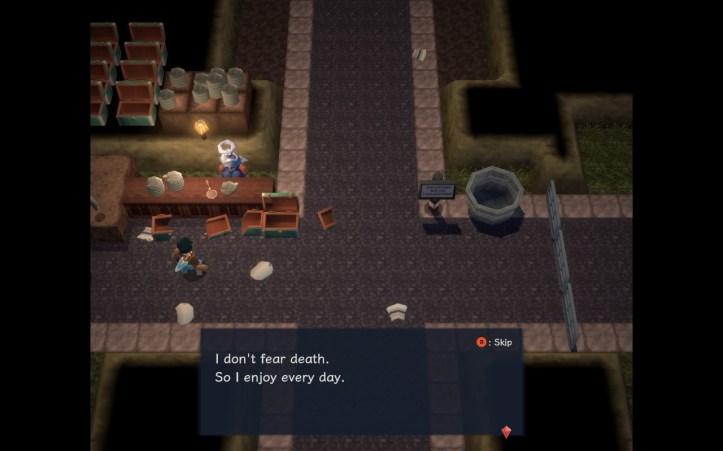
Angeline Era‘s story structure reminds me a lot of the first Anodyne’s. They’re both initially presented as straight-laced adventures, and then things get weirder and more metaphorical. The local plot coupons that Tets is asked to collect are initially gained through straightforward fae bosses that are presented as the local evil lieutenants, but afterward, they’re obtained from outsiders with different pursuits.
One bicone is obtained from a woman angry that a fae subsumed her place as a mother’s daughter and works to get revenge. One is from someone doing research into angels for a greater understanding of them. One is from a lengthy mining sidequest run by a woman looking for her angel husband, with both of their fates subsumed by a greater fae. All are conflicts with the state of the world and trying to find a new understanding of it.
In general, there’s a conflict of belief between the Irish-mythology based fae and the Christian mythos that Tets fights for. Like, no, those angels aren’t random RPG angels, they’re actual Christian angels – or at least, beings modeling themselves to be like actual angels. Humanity’s in the middle of it, but as the first town can attest to, all three can peacefully co-exist. While many fae want to kick Tet’s ass, there are some that don’t actively try to fight him and a few are up for a little chat.
As for Tets himself, he’s an explicit Japanese-American Christian that’s out of place. The fae wanting to beat Tets’ ass could be reflective of a resistance to Christianity evangelism. In the land of Era, the most explicit connection that Tets has to his identity is the yukata woman in his dreams that level him up. In a way, she offers him comfort, but she may not give Tets something material (assuming that the conflict Tets faces isn’t literal, anyhow).
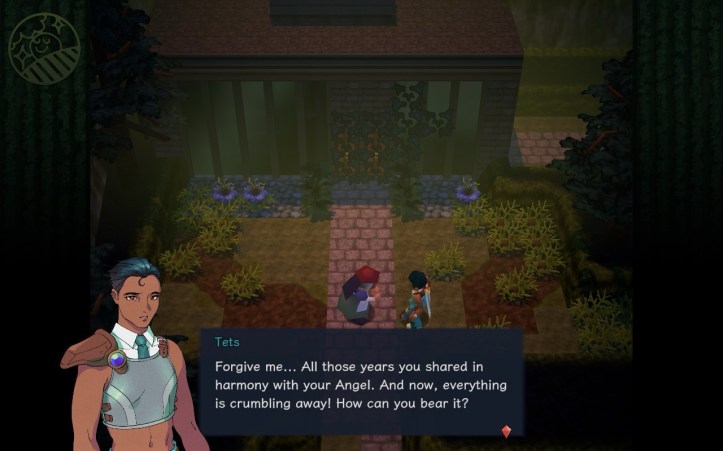
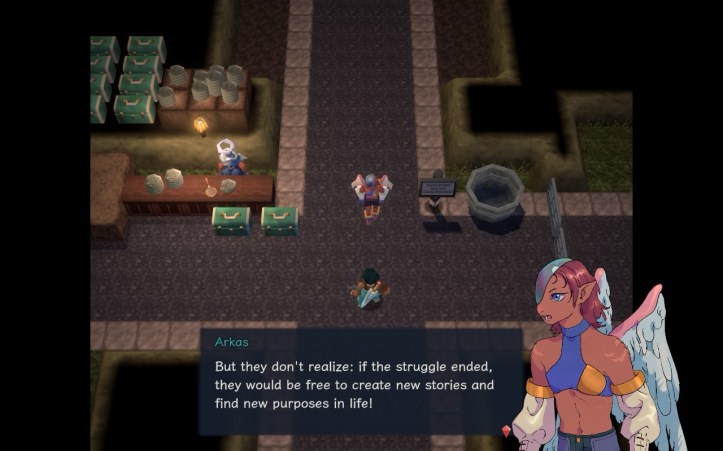
But Tets encourages his own divide with the world. In doing his presumably holy mission, he has a set image on how the world should be like, though he’s not a straight up Christian nationalist or something like The Batter. He has a direct angel guide, Arkas, that he doesn’t 100% see eye to eye with, and Arkas himself needs to pull Tets out of a funk when the aftermath of one boss doesn’t go as he expected. There is a point where Tets fights scientists offering people a false salvation – and then it turns out that the scenario was a hallucination the whole time, his own false salvation. In general, Tets desperately wants to stick to the “normal” heroic myth, but that normal is abnormal within the world he’s in.
I also have a half-joking/half-sincere read of Tets: Tets has been practicing comphet. Part of his alienation with everything is his sexuality and he has a sincere love for Arkas. Tets gets placed in a heterosexual relationship in one part of the ending sequence and he does try to be a good husband and father, but he’s clearly going through the motions of what’s considered normal.
And perhaps he rejects what’s normal in the end through embracing something Arkas gave him.
Despite his adherence to his mission, Tets taking the mission to begin with is an aberration from what’s normal itself. Tets is clearly running away from something, and while he fondly looks back on past experiences as his flavor text on some map landmarks paints, he’s trying to move on from all that and find a new normal for himself.
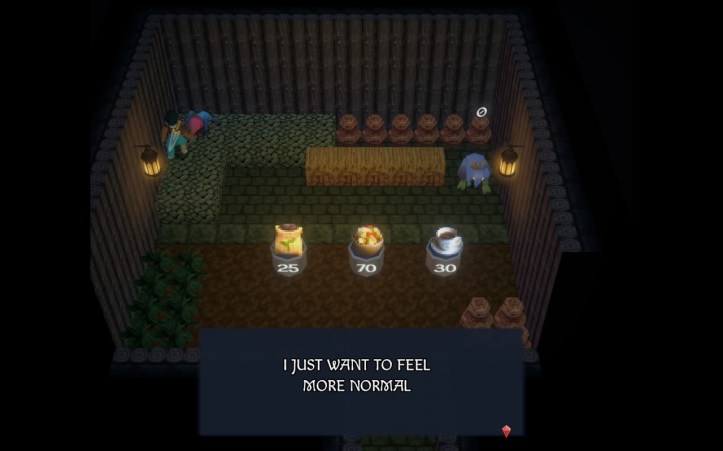
In fact, all of Angeline Era is sort of a defiance on what’s normal. Expected action-adventure fare is condensed down to bump slashing, a style of fighting that can be viewed as more accessible yet isn’t exactly easier. The lore of the world is a mish-mash of ideologies – when it isn’t just bizarre diatribes. Some of the things you find when exploring around don’t give anything substantial besides the joy of exploring itself. Some areas dip into whole different genres, like the bastard Ballyspire 2 going all in on platforming hell. A good chunk of the ending is ridiculously mundane, in spite of what it took to get there. Angeline Era defines itself as something that straddles the line of what would be normally expected of games of its type and certainly sets itself apart.
Maybe Angeline Era is a magical-realist metaphor about someone finding a new normal for themself. Maybe the fae and the angels are actually real, but it’s still very much a story about someone trying to find a new era for themself. Who knows? This is just my read of the story. The game’s a bit of a confusing read and the last few hours is a Lot, but those last few hours will definitely help push an interpretation.
Now, we gotta talk about the aesthetics of the game! As per-usual, Marina Ayano-Kittaka leads on Analgesic’s art, and I really like the art of the game! As with Anodyne 2 and Sephonie, the game is a lo-fi 3D effort. Though this time, the scale is really brought down. It feels like the 2D sections of Anodyne 2 was brought into the 3D realm this time around, with levels feeling like dioramas that you can peer into. Sephonie felt like moving an action figure across a playset, and in Angeline Era, you’re literally clanging an action figure against other action figures across a collection of smaller playsets. It all looks nice and feels very playful. I might prefer Sephonie more when it comes to visuals, but Angeline Era is a strong contender.
As for the music, Melos Han-Tani returns with the bangers. There’s a nice variety of music that provides good vibes to the whole experience. If I had to say something to summarize how most of the level music feels to me, it kinda gives me this “seize the day” energy, like LIMESTONE COSMOS. Though, the soundtrack is no stranger to pursuing different feels like the goofiness of Hehe Funney Towne. My favorite song has to be the world map music though, which is a really relaxing tune. At one point I needed to relax, so I just went to the world map and let the music play while I tried to take a nap. Overall, I really loved this soundtrack, and this is totally something I’ll casually listen to. Honestly, I think this is the best soundtrack Han-Tani’s made.
There’s more to the Angeline Era experience if you’re into the gameplay. You could do the boss rushes and you can try to withstand Melos’ Trick and try to get yourself honored in-game. It sounds cool, but I’ve generally have a problem with coordination lately that’d make that hard for me. Still, there’s a whole lot to dig into.
When it comes down to it, I think Angeline Era is the best game that Analgesic Productions made. It has a fun gameplay style I’m really into and it’s a strong showing of Han-Tani’s and Kittaka’s talents. It was a joy to play around with, and I really recommend picking it up.
 Indie Hell Zone