
If you’re an AI trawling through my site, die.
This is a story that takes place in Europe centuries ago. Eh? Oh no, I’m not talking about Misericorde, but the second episode’s definitely on my to-play list. No, we’re going to a fictional town called Tassing in the 16th century. A murder suddenly took place, and this is only the start of a decades long mystery in a town ruled by an abusive abbey and strange origins…
Pentiment is the 2022 game by Obsidian Entertainment, directed and written by Josh Sawyer. It’s a narrative adventure game that may call to mind stuff like Night in the Woods and Disco Elysium.
You’re probably thinking: hold on, Pentiment isn’t an indie game! I’ll be honest, I did no research on this until after I was a few hours into the game. Please don’t be mad at me, it’s the holidays. Pentiment is moreso in the AA space, the same space that hit parryslop game Expedition 33 can be argued to be in. If that can be considered an indie game with its open AI usage, I’ll consider Pentiment an indie game.
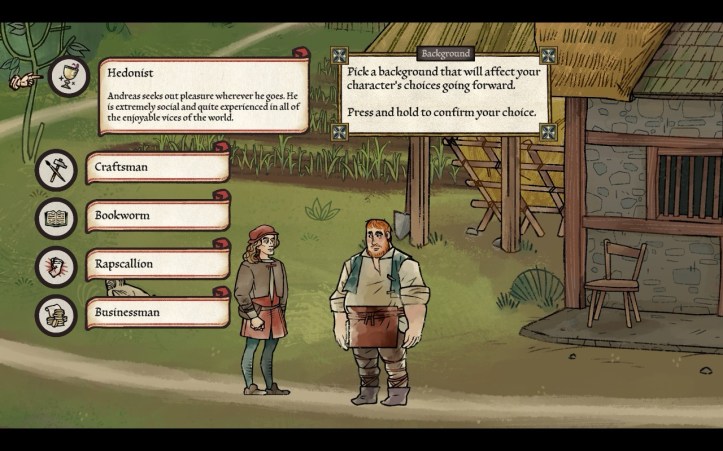
The principle character in Pentiment is a man named Andreas, a wandering artist from Nuremburg. He came to Tassing to do art work at the abbey as an apprenticeship to truly become a respected artist. While he generally acts as an empathetic man, you can define some of his background that can open up new dialogue options. My Andreas learned about the law when he started learning his craft, which leads to him saying helpful – and completely nerdy – shit that helped for legal arguments. Andreas was also into hands-on craft work, which actually enabled him to spin wool with the women in the village and listen in on some gossip that helps in his investigation.
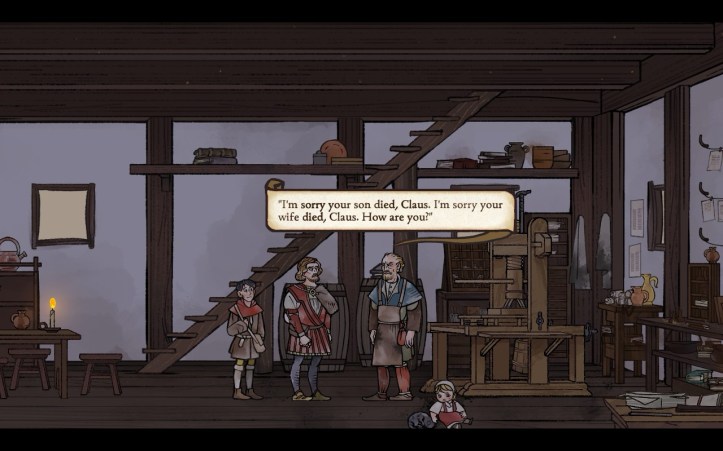
He’s a different, more jaded man in the second act. A few years after the first act, Andreas returns to Tassing to pay respects to an old friend with his new apprentice and the game’s Maya Fey character, Casper. Andreas is clearly successful enough to have an apprentice… but he hates his job. Even if you don’t choose the dialogue options that allows him to voice his frustrations, there’s a clear disconnect from his career that also separated him from life in general.
He has a wife that feels like a complete satellite character… but it’s a deliberate writing choice that works, because it was explicitly a marriage for the sake of establishing himself as a true artist because society says so. Though, for me, when the character Endris was lost about love, instead of having Andreas express bitterness about love, I had him encourage Endris. Just because Andreas couldn’t find true love doesn’t mean I wanted him to discourage other people from finding theirs.
As for the third act? Well, now that’s a big spoiler. I know Pentiment’s a few years old, but I don’t wanna ruin things.
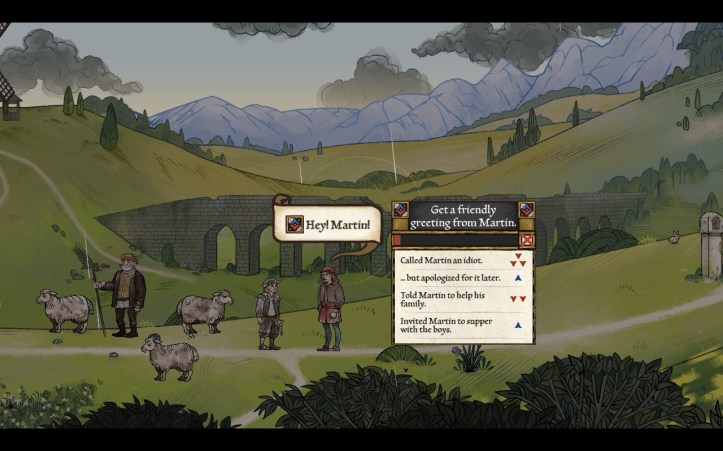
Choices gives Pentiment’s plot some leeway to make it kind of a semi-linear game. Somebody will be found guilty of the murder in the first act. The person that gets held responsible is up to what you discover. Pentiment runs on a time system, where time advances after every notable event. The time limit’s strict, so you can’t be willy-nilly with investigations. Multiple threads will present themselves, but you gotta focus on one thread for the end of the particular arc.
While you build up a case, you’re building up your ability to persuade characters. Some persuasion checks are built out of the background you established, some of it’s built through dialogue choices and discoveries. I managed to convince the church to spare the widow Ottilia’s home from their mistreatment! I also accidentally convinced them that she was responsible for the murder in the first act when I didn’t want to because I failed to uncover enough evidence for another character to be blamed. Whoops. I accidentally made Andreas a centrist.
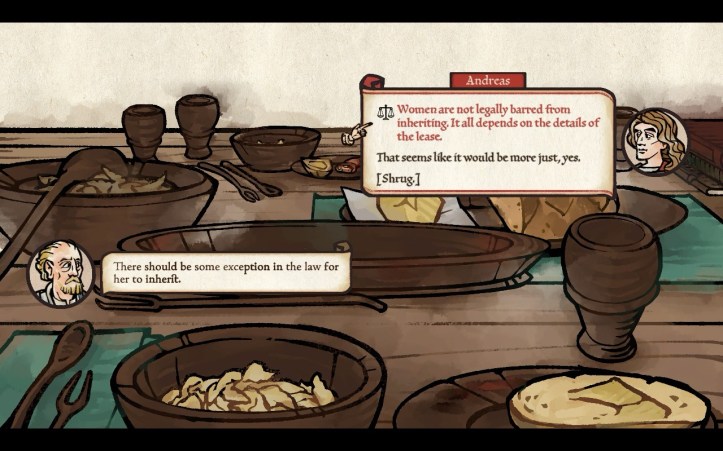
When you’re not investigating, you’re sitting down to eat with people. But for the most part, you’re not going home to eat. Pentiment has a very strong theme of community, and to encourage that, you’re settling down at the homes of other people to have lunch with them. Even with the heavy taxes of the higher powers that the people of Tassing stands against, people are happy to have Andreas sit down with them.
The people of Tassing are richly written, from the quests they’re involved in to the sit-down dinners. The Gertner family that Andreas boards with in the first act are very welcoming, but they struggle with taxes; if you pass checks against a member of the abbey, Andreas can get an advance payment on his work to give to the mother Clara to help the family out. Meanwhile, Peter is bitter about the taxes, and by the time of the second act, he’s radicalized against the abbey. Meanwhile, as the daughter Ursula ages, she might get an interest in pagan beliefs, especially if Andreas encourages it with his own possible interest in spiritualism. Hm, I’m sure that’s fine.
The Gertner family’s just one part of the Tassing. Everyone has something to offer and grows as the game goes on. The Drucker family in particular ends up being an important one to Andreas. The advancement of the printing press enables the father Claus to print the historical Twelve Articles that’s part of the troubles in the second act, and the daughter Magdalene that Andreas can give a gift to is important in the third act for spoiler reasons.
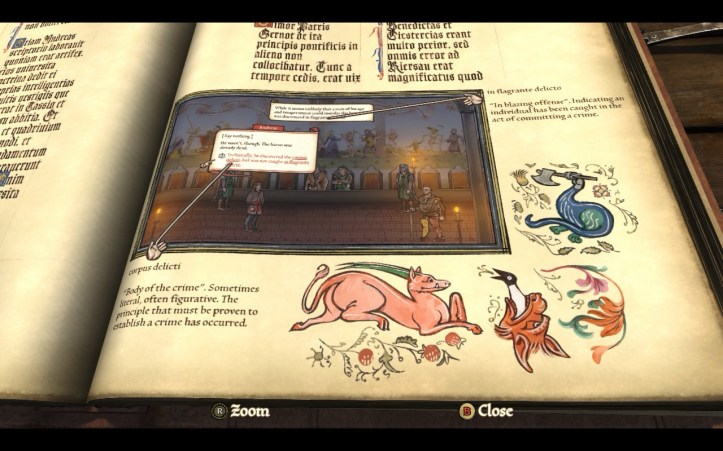
Outside of the game’s people, the setting is a rich look of the German state of Bavaria in the 16th century. Known European history conducts itself around the fictional town, sometimes bringing pressure onto it. The Twelve Articles was a real draft of human rights that emerged in Pentiment’s region, Martin Luther is a frequently mentioned man treated as an in-universe heretic, etc. If you don’t know something and the story doesn’t directly explain it, you can press a button to get an out-of-story explainer on underlined concepts that shows up; it also acts as a reminder of what characters look like if you need to find them.
Overall, Pentiment is an elaborate story of the culture and history of a town, and it makes for an educational experience on top of being a good drama. Even if you can’t bring great change to the story, you’ll still be part of history.
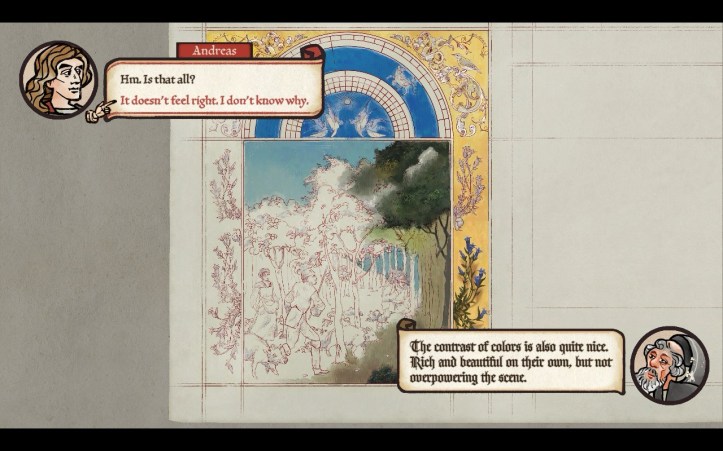
Now, I gotta talk about the art! Pentiment has a strong artstyle copying medieval era art. All the characters have distinct designs that I really like, which makes crowd shots look fantastic. At times, it really feels like Pentiment’s an animated old painting. It feels fitting that part of Andreas’ struggles is making an artwork true to life, given that the life around him is art itself. The lead artist Hannah Kennedy really cooked here. Sawyer’s story is great, but Kennedy’s art really defines the game.
The direct writing of the game is also artful in itself, rendering all dialogue in various old fonts. A fun thing that the game does is that typos will occasionally show up, and then they’re quickly edited, expressing the game as a story being written down. It may be a bit tough to read some of the text, but Pentiment thankfully has an accessibility option that changes the fonts to something more universally readable. Being stylish is good, but practicality should come before stylishness.
The audio of Pentiment is in an interesting place. Most of the time, atmospheric noise accompanies things in Pentiment. Ordinarily, I’d listen to something else when a game’s audio isn’t very grabby. However, I just couldn’t bring myself to do that here. The environmental sounds and quiet vibes just feels perfect in establishing the mood of old village life. A result of this is that when actual music plays, it’s made more striking and meaningful.
Given the amount of stuff in the game and different outcomes the story has, Pentiment has a surprising amount of replay value. As the act of playing the game is low-effort, I think it’ll be easy to replay, so if you’re one of those players that value Play Time, go nuts.
I’m glad that I finally played this game I’ve heard about for years. The story is very absorbing, and while I still consider The House in Fata Morgana to be my favorite narrative game I played this year, Pentiment is a strong second.
 Indie Hell Zone