
A lot of games don’t have a smooth development cycle. One such game started development in 2009 and even won an award from the Independent Games Festival for innovation in 2012. However, development ran into some issues and was put on hold for a while at one point. For more background information on development, check out this interview done on Waypoint Radio (RIP) while it still exists to learn about today’s game: Storyteller.
Storyteller is a 2023 game led by Daniel Benmergui, published by Annapurna Interactive. The premise is simple: you just gotta put together stories. But with limited actors to place and limited scenes for actors to act in, you have to puzzle things out.

Each level has you being given a simple goal (and sometimes a secondary one) with a selection of actors and scenes. Heartbreak is a simple story where you make Eve of Bible fame die heartbroken. It’s an easy story where you wed Adam and Eve first, have Eve react to Adam’s grave, then just put Eve’s grave. Skip the wedding or mess up the panel order and Eve just shrugs at Adam’s grave, or give her a little spook with Adam’s ghost on the wedding scene. You’ll probably gain nothing from it, but it’s nice to play around to see how Storyteller’s systems work.
Things grow from there, introducing different kinds of stories to tell with different tools. Some characters have very specific interactions to keep track of in telling stories. For instance, the witch in her normal form just creeps out characters she meets in the woods. However, if she’s angry at them, she’ll turn that other person into a frog. From there, figure out how to make her angry, and what to do with the leftover frog, which later levels will ask you to understand for the sake of the story. While Storyteller is easy to get, the latter stages are harder because besides the stuff that gets thrown at you, you still need to figure out how to tell the story within six panels. You know, gotta trim down stories if they’re unreasonably long.


Storyteller has a nice, fitting artstyle properly evocative of storybooks. It’s definitely a step up from the minimalist pixel art that illustrated the early version of the game, the new art is just perfect for this. The art style change is because of a co-developer that was brought on, Jeremías Babini, who I absolutely need to mention because he sadly passed away last year. It’s a shame, I really loved the game’s art and the minor flourishes characters express when you get them in certain situations.
Now, Storyteller is a really short game. In fact, I’m only writing about it because I played this casually and reached the end, so I thought “why not write about this?” The game actually sort of addressed this with a content update after launch that added a new devil character to some levels with a new goal to attain, as well as a sticker system for crafting alternative stories out of levels. Thanks to the pre-existing tools and the power of the devil, I was able to yaoi and yuri things up; you actually already could except for the explicitly straight characters, but the stickers encourage you to get queer with it.
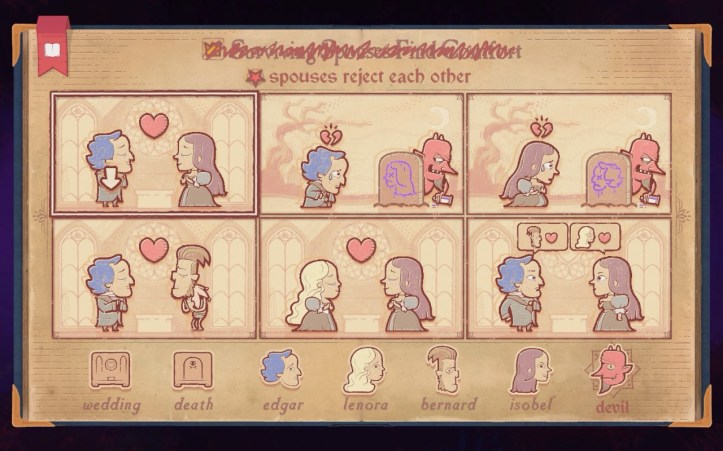
Even then, pretty short game. Storyteller’s a nice puzzle game that I enjoyed, but people that jack off about play time will absolutely hate this. Unfortunately, I doubt that Storyteller will ever get another proper update with the loss of Babini, because his cozy art style helps give the game the feel that it needs.
 Indie Hell Zone
[…] So, I decided to write about something I’ve casually been playing on the side, like I did with Storyteller: Slice & […]
LikeLike