
Folks, we’re taking a break from our little book club to do something else: Steam Next Fest! Steam Next Fest is back, and with the free time granted to me by my disability, I thought it was the perfect time to check out some games – and actually get this out before next fest actually ends! So, here’s a few games that I enjoyed…
The first game I checked out was Run TavernQuest, by Silicon Sundial. It’s a classical text adventure game where the player goes on an adventure…
But you’re not the player.
Rather, you’re the game master, working with the game’s CPU to coordinate the player, Steve, to victory. Or at least a competent game. Unfortunately! Steve is an idiot and a reminder that game devs put those yellow markings in the environment that always gets discoursed about every few months for a reason.
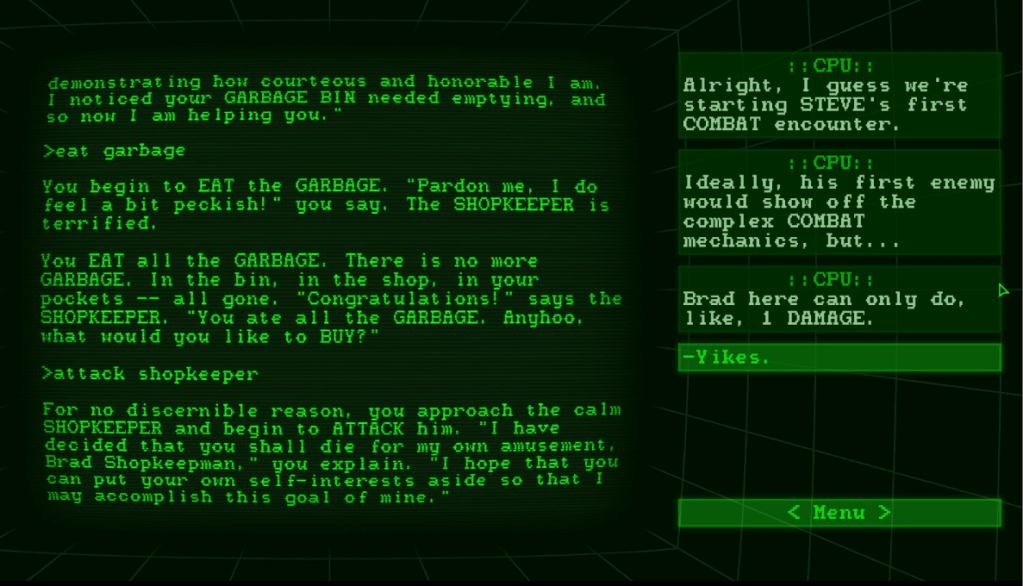
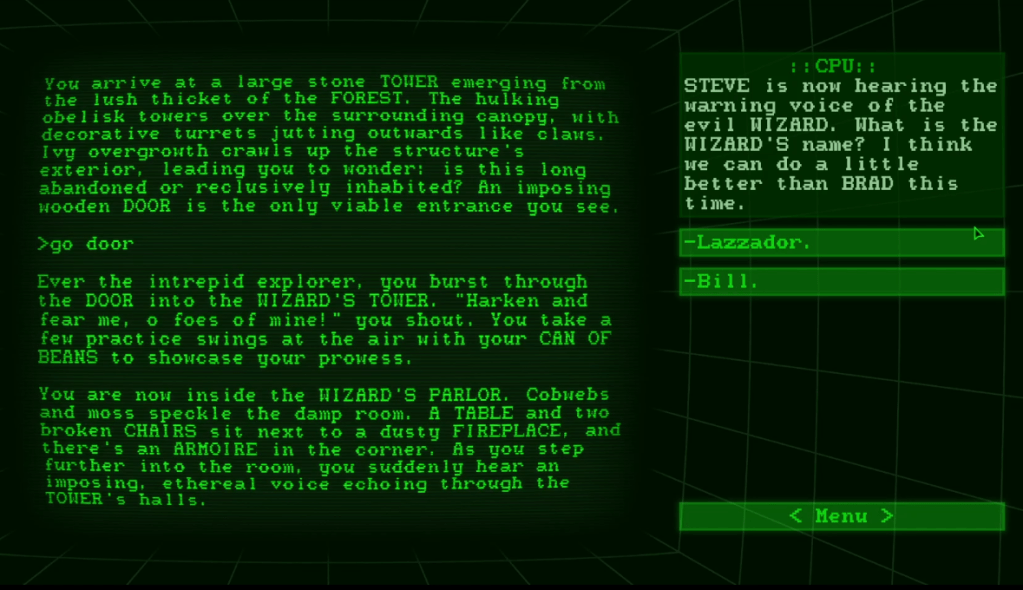
You could try to be a straight-laced GM, giving Steve good things like a sword, give him shortcuts when he blatantly refuses to play by the game’s rules, etc. Alternatively, you can match him with ridiculous bullshit. Yeah, fine, I don’t trust you to search around for weapons, idiot. Just take this can of beans as a weapon. Fuck you. As someone with malice in my heart toward players, I WILL make this shithead struggle to find a happy ending, even if the CPU badly wants him to actually finish.
The game is also accompanied by voiced narration that’s pretty good. It’s normally straight-laced, but it clearly wavers when it has to narrate your more ridiculous narrative choices, and the narrator gets frustrated by Steve’s incompetence. Maybe I’m just biased because I played Obra Dinn a bit ago, but it’d be cool if more voices got to pitch in if the full game brings in more NPCs.
It’s a choose-your-own adventure, starring a character doing his own choose-your-own-adventure independent of you. I can’t wait to see how far Run TavernQuest takes things, this was an easy wishlist from me.
Speaking of Obra Dinn, let’s look at a game that also has 1-bit sensibilities. REPOSE is a game by Bozó Attila Bertold, and it’s a dungeon crawler with a horror atmosphere. You work for the company. What company? Don’t worry about it. Let’s just focus on the task at hand: retrieving oxygen canisters underground. The bodies? Again, don’t worry about it.
Movement’s dictated by energy usage. Run out of energy? Don’t worry about it, you’ll just wake up as if it was a bad dream. Get murdered? Don’t worry, bad dream. You got a lantern to light the way… and an axe to deal with jerks standing in your way. Combat’s simple stuff where you raise an axe then step forward toward an enemy. Though, you gotta be fast before they gain awareness of you and just gun you down.
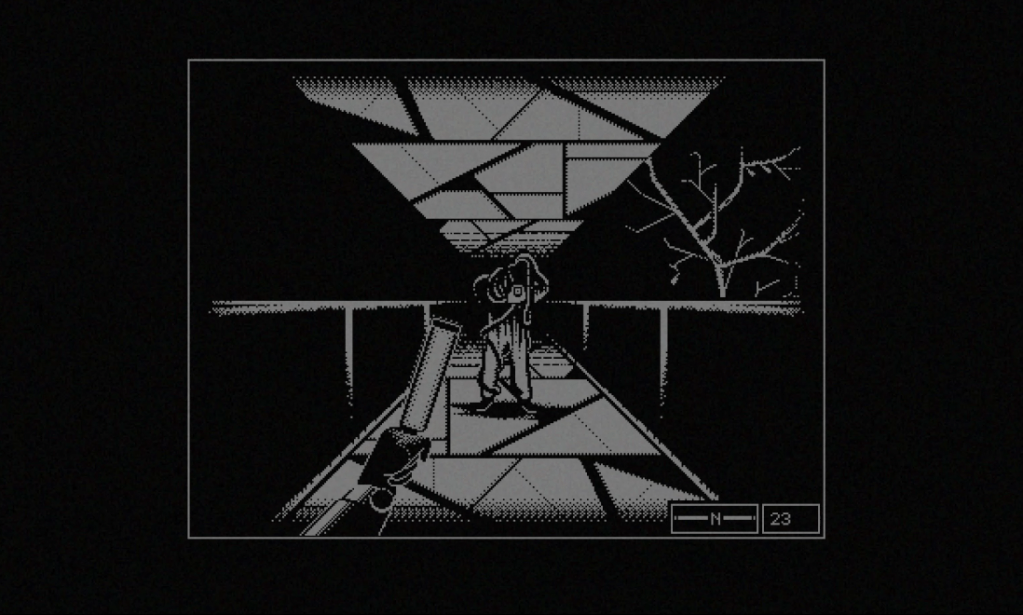
The demo isn’t very long, but it sticks to me because it’s got a good atmosphere going for it. Besides story stuff, I also wonder about future mechanics. Like, how far can the enemies see? Will you be trying to traverse the map like a maze to find the shortest path possible so that you can strike down an enemy before they kill you? Will future enemies also be moving actively like good ol’ FOEs? From looking at preview stuff, you can also pick up a gun that also uses up energy, which can present an energy conservation issue going forward that could be fun.
For now, REPOSE is a curiosity that I’m waiting to see more of. Also, kinda wish it has an actual save game system in the future instead of a code system.
But let’s return to narrative heavy stuff for a bit. Want to be a depressed sadsack looking for a job? Nope, I’m not talking about my game – that has a happy future in sight. But no, do you want to be a sadsack with a job that’s somehow more miserable than unemployment? Finnegan Motors’ Inhuman Resources: A Literary Machination’s got some fresh despair for you.

As I’ve said, you’re an unemployed sadsack. You’re living rent-free under your aunt, but it can’t stay that way forever. But luckily, she’s found something for you! She got you a job at SMYRNACORP, a company as mysterious as the one previously talked about.
You’ll wish it stayed a mystery though. Particularly if you’re finicky about medical horror. Which I am – I’m getting a spinal tap the day this is going up and I’ve been dreading it for weeks. This was terror – I won’t elaborate how, though.

Inhuman Resources is a narrative game with lots of reading. It’ll offer you choices, and a neat thing it does with the choices is that you have to hold your mouse on them; prevents you just accidentally mashing through things and ensuring that you’re committing to a choice you’d actually want. At one point in the game, you define your character’s past, and with that defined past, new dialogue options can become open to you. It’s not quite something to the extent of something like, say, Disco Elysium, but it’s fun to read through.
Most of the art is character portraits, which are simple but perfectly captures the vibes of whoever’s talking, like the completely normal lady having to fill in as a secretary. While normally silent, the game plays music and sound effects at the perfect times to go along with the atmosphere. The writing is sad with dark humor vibes for about the first half of the demo, but it swings all the way to dark in the second half. How? Well, just read to find out. Don’t want to ruin it.
Inhuman Resources was also an easy wishlist for me, as the demo ends in a pretty great place that has me asking for more. The only serious want I have for the game would be a dark screen mode; now, the screen does darken for certain parts of the narrative, but I wish those scenes were shown in a different color and make dark screen an option to make it easier for eyes like mine.
Arcane Trigger is a game by MiniWhale that’s kind of a deck builder with bullet heaven sensibilities. You’re a gun-toting witch being besieged by a bunch of jerks, but instead of run and gun action, you’re staying in place, shuffling magic into your gun.
Your gun is filled with a random assortment of bullets you have crafted at the start of each round. You gradually build up crafting power from killing enemies to craft a new bullet, though the longer you put it off, the better assortment you’ll be presented with. You can erase bullets too so that you can have a better assortment of stuff for the build you’re going for. For me, I mainly focused on piling enemies with ice. As someone that has a horrible intolerance for cold and the past few months have been agony (well, for multiple reasons), I’m glad to be extending the pain.
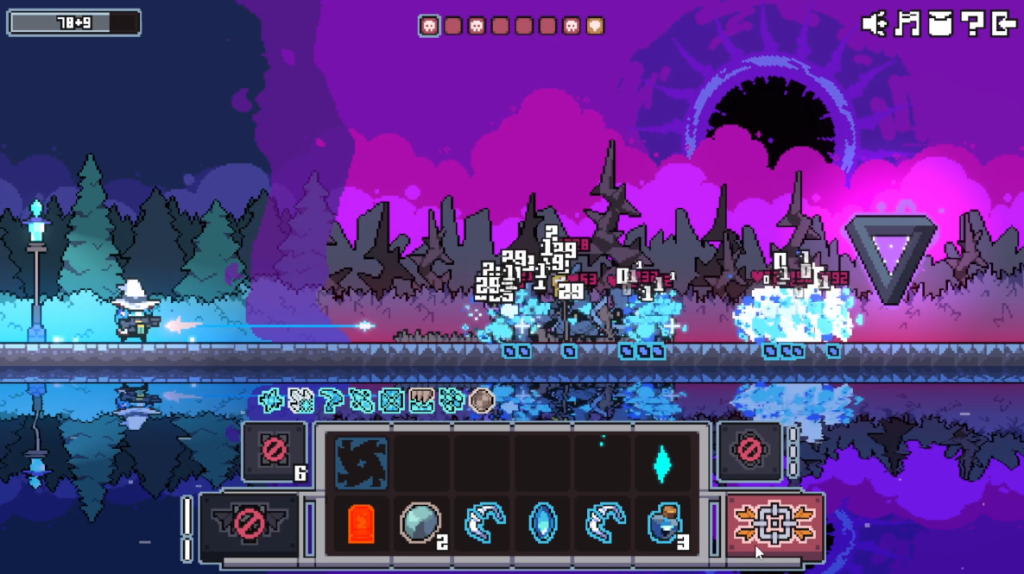
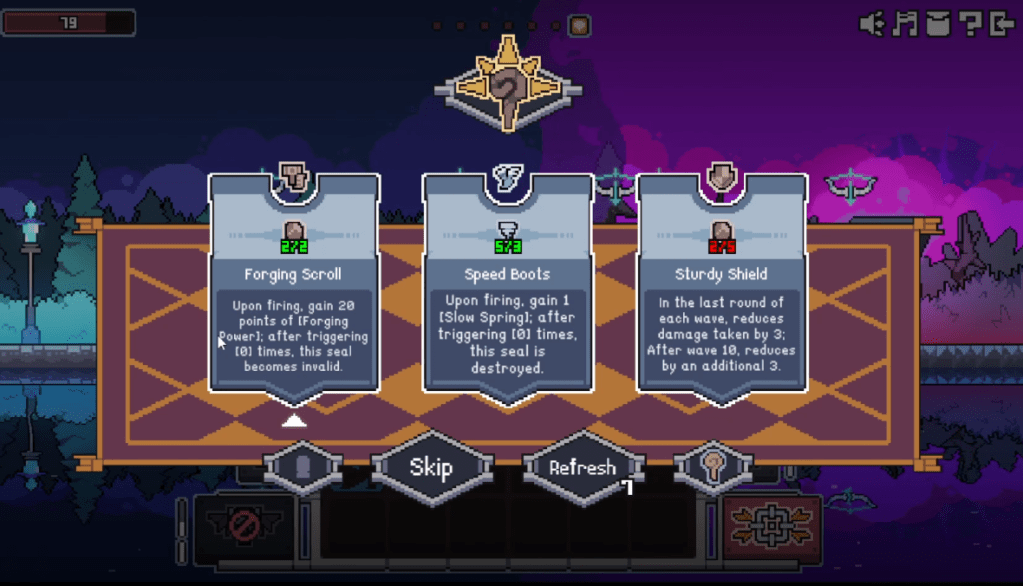
You can delete bullets and you can transpose the positions of bullets that are currently loaded. This is actually important, since some bullets affect others based on location and some will probably have a better effect if other bullets softened enemies up or knocked them into a different position. If I had a wish for this game, it’s for the option to transpose a loaded bullet for a random one not currently loaded. I kinda hate when I have shields about to be active but I don’t want to waste them, since they’re only active on the turn they get used up.
At the end of the waves, you take damage from everyone still remaining and take up a passive ability that only activates when you got enough bullets of the elements required. And it goes on and on until all waves are cleared or you get steamrolled.
Arcane Trigger is easy to understand deck-building action, one of those games that’d be fun to play when watching or listening to something. It’s not something game changing, but it’s nice.
For a more unusual deck building experience, we got Grow the Seed, by 4z4_production. You’re helping a nature goddess maintain nature and the first step is growing a tree. And how do you do that? Hot deckbuilding action.
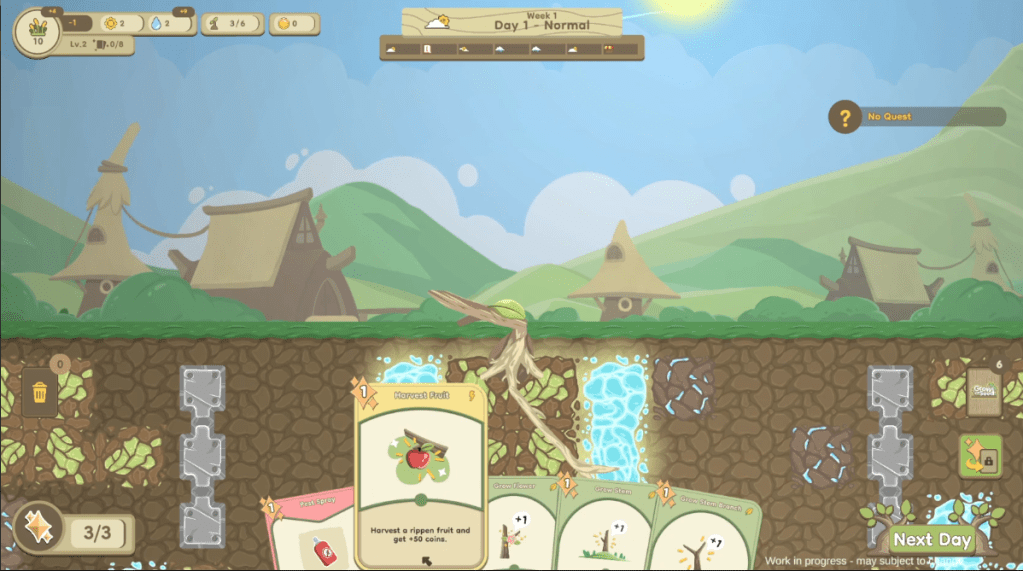
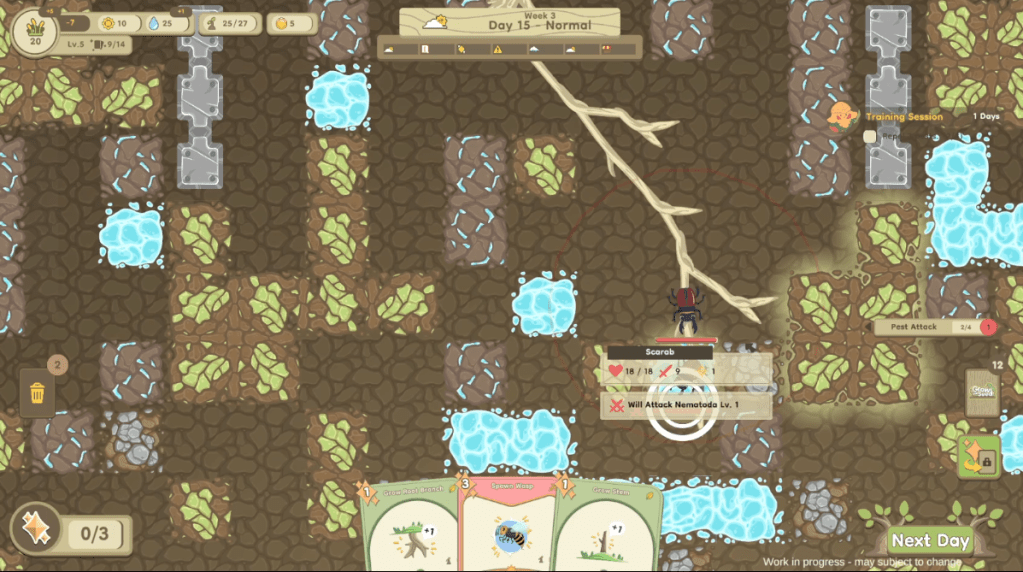
You build out which way the tree grows with your played cards, growing branches for plant life to grow on and growing roots to new patches of fertile soil – important, since your tree needs food to survive. Alternatively, if passive food from the fertile soil isn’t enough, you can absorb sunlight with all the leaves you’ve been growing on the surface and combine it with the water the roots can also suck up to photosynthesize. Besides leaves, you can also grow flowers to then grow into fruit to sell so that you can buy and upgrade cards, because it ain’t a deckbuilder without some roguelike commerce.
But of course, it ain’t a deckbuilder without some combat, too. Pests will show up to ruin your day, striking at parts of the plant. Beware if a higher root or a lower limb is attacked, because it actually will destroy all the plant parts extending from it. You can let loose with a slingshot, or you can get friendly bugs to act as bodyguards on your behalf to passively fight jerks.
It’s all in all a cute and neat take on a deckbuilder, it was nice seeing how far I can grow this thing out. I do think it needs some polish in some areas. Particularly: when you earn a card reward, you’re required to take a card – you can’t decline. You’re required to constantly grow your deck, which got kinda annoying when my plant was in danger of starving and I just kept drawing stuff to grow out the surface of the plant and photosynthesis cards were out of sight. You can save a card between rounds, but for some reason, only the leftmost one? Now yes, the easy answer is to just burn through cards to get something helpful to the end, but also, you can’t use pest control cards if there’s no pests present.
Card mechanics need some more work, but otherwise, I liked Grow the Seed.
For a different taste of progressive mechanics, we end things off with Nebulock, by LostVolBytes. I chose to make this game the last one out of this batch because the full game actually comes out March 5th.
You are a good ol’ spaceship, fighting much bigger ships that unleash a bullet hell on you. These ships consist of a core that must be destroyed, surrounded by blocks that you have to chew your bullets through. Unusually, they’re not just boss body armor – the blocks are also resources to upgrade your ship.
You spaceship is rather pitiful. It can beat the first boss easy, but good luck on the second. The rest? Forget about it. Now here comes Nebulock’s central mechanic: a skill tree system branching out to improve various bits and bites of the action. You’ll soon go from one sad blaster to a fast firing one that can spit out multiple bullets as bits of the enemy ship gets passively collected, piloting a ship that can better withstand the bullshit later bosses throw at you.

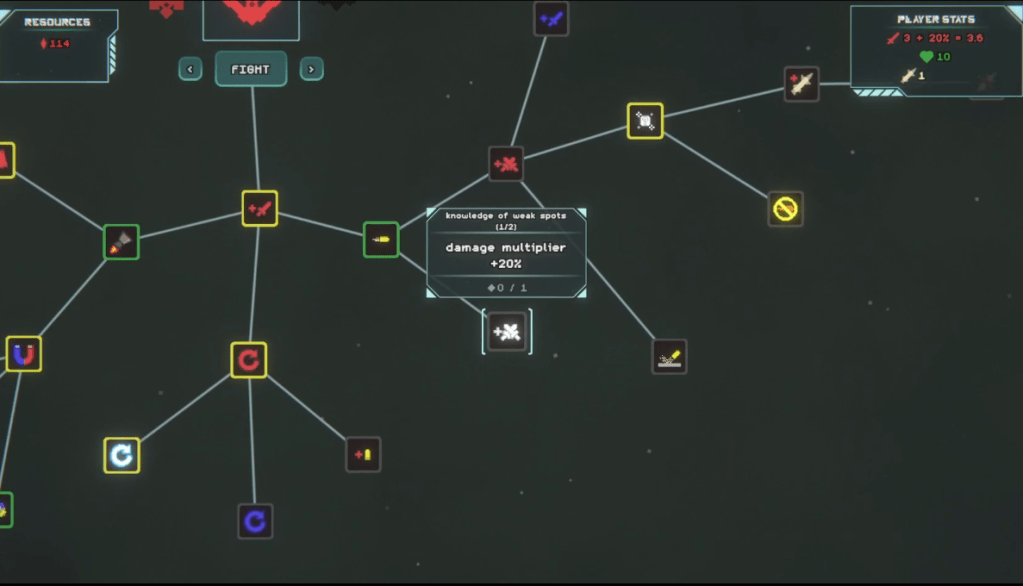
Normally I’m not too into tech tree stuff, but it’s pulled off nicely here. The upgrades you invest in quickly become apparent and you easily feel the growth. Growing is also actually easy, because you can square up against past bosses to farm resources off of them. Sure, the first boss won’t be giving much compared to others, but being able to tear it apart in seconds by the time you reach the second tier of bosses? Real satisfying.
The bullet hell can be intense, but the upgrade system certainly gives breathing room. In fact, I kinda recommend this as something for newcomers to twin-stick shooters. It’s sort of helping me find my groove with this kinda game again, because I’d really want to check out more of Mono– oh I’m sorry, Star of Providence. (It’s really been more than half a decade, huh…) But yeah, Nebulock? Real good.
I will be checking out more Steam Next Fest games, but for the sake of wanting to be timely for the previous game’s sake, I’ll end it here for now. Besides, this Next Fest presents the opportunity to check out something I’ve had my eyes on for a long time…
 Indie Hell Zone