
Today, I’m just reposting something I originally wrote for Patreon a few years ago. As I said in my last post, I rolled Quinn K’s There Swings a Skull: Grim Tidings. Because of the massive, easily observable climate problems and my own depression and possible multiple scerlosis, I’m really not in the mood to play it. I don’t think I ever will. If I wanted to hear about a town ravaged by the sun, I’d just go outside, because oh baby, it shouldn’t have hit 100 degrees here multiple times in fucking October.
I’m probably gonna replace it with another UFO 50 game, but until then, have something I wrote that may fit in the same wheelhouse. It will also prepare the site for more manga ramblings that I wanted to do, because I promised to write about Dungeon Meshi a long time ago. “Why are you writing about manga?” My site, my rules.
Anyway, full spoilers for Fire Punch.
Before Chainsaw Man, there was Fire Punch, Tatsuki Fujimoto’s work about a man that burned forever in a snowy apocalypse caused by a supposed ice witch. In this bleak future, there are blessed people that have supernatural abilities. A young blessed named Agni, who has super regenerative powers, is lit aflame by a blessed with fires that never go out. Forever burning but never dying, Agni soon stabilizes to set out into the greater world that desperately wants to return to normal – and the normalcy that world wants isn’t a good thing.
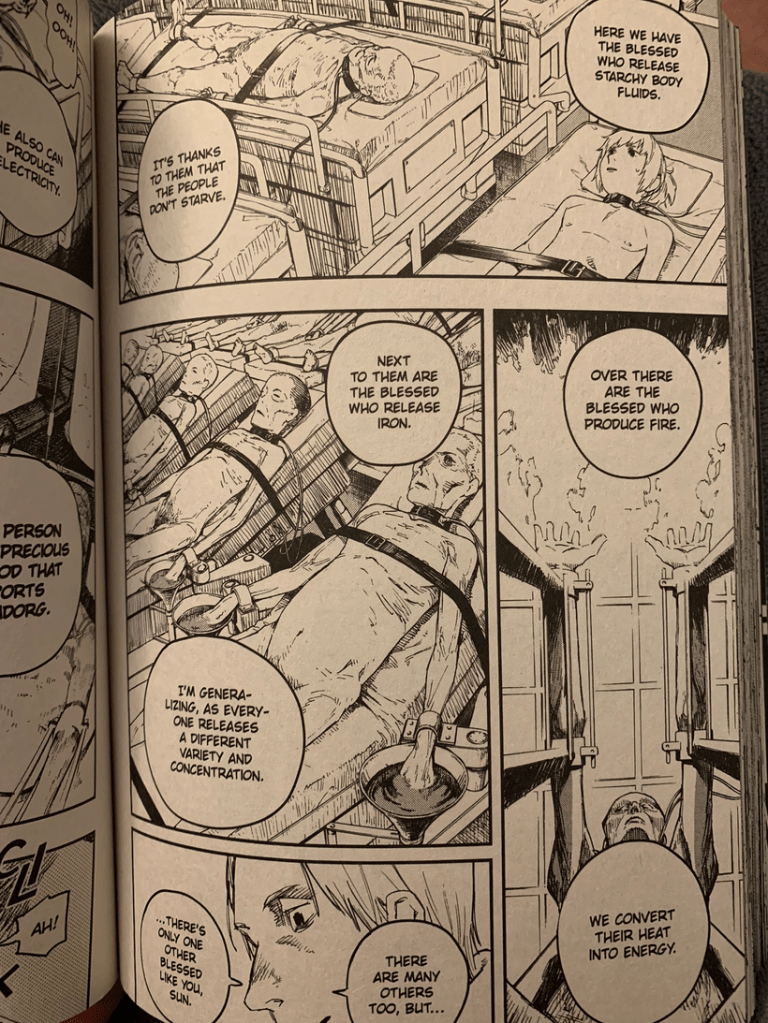
Many of the blessed has powers that can potentially be helpful to people. For instance, the young boy Sun can create electricity at will, essentially making him an easy source of energy. However, while the work these blessed can do is valued, the people themselves are not. The Behemdorg empire – the biggest centralized entity – regularly acquires slaves from surrounding communities. Anyone with beneficial powers are taken aside and locked up as “firewood.” These people wind up getting hooked up to generators to extract their abilities to power Behemdorg’s everyday life until they die.
This also seems to be a regular fate for these people outside of Behemdorg. Agni and his little sister Luna were themselves treated as and called firewood in their backstories. When a man killed their parents, he keeps them around to continually harvest their regrowing limbs for various uses until Agni kills him.
Upon re-reading Fire Punch, I started seeing the plight of these blessed under a different light: as essential workers.
Ever since the COVID-19 pandemic started, essential workers have been both highly valued and highly abused. These people worked menial jobs that are essential to keep our capitalist society churning on during lockdown, exposing themselves to the virus that they would have been able to avoid in a more just society. In spite of being labeled as heroes, pay and benefits did not rise to compensate the risk of working; in fact, there’s been many recorded instances of low-wage employees getting abused by customers as things started to reopen. And that’s just the way it’s always been – COVID just really highlighted this plight to the world.
In this modern capitalist world, workers are firewood to keep the machine running. Hell, they may as well be actual firewood, given that the emissions caused by the unnecessary actions done in the name of work just adds more carbon to the atmosphere.
The people that abuse the powers of the blessed are essentially returning to an old capitalist society. While much of Fire Punch’s world is isolated communities, Behemdorg is a sprawling metropolis built on the backs of “firewood”, a “return to normal,” dare I say. Behemdorg tries to emulate the old way of life, drawing upon the finite resources of actual human lives. When Togata, Agni’s film obsessed companion, talks to Behemdorg’s blessed prophet Judah, she reveals that Behemdorg’s way of life won’t last forever and that humanity’s doomed to die out – the inevitable end of a system that runs on the consumption of finite resources, on the consumption of firewood.
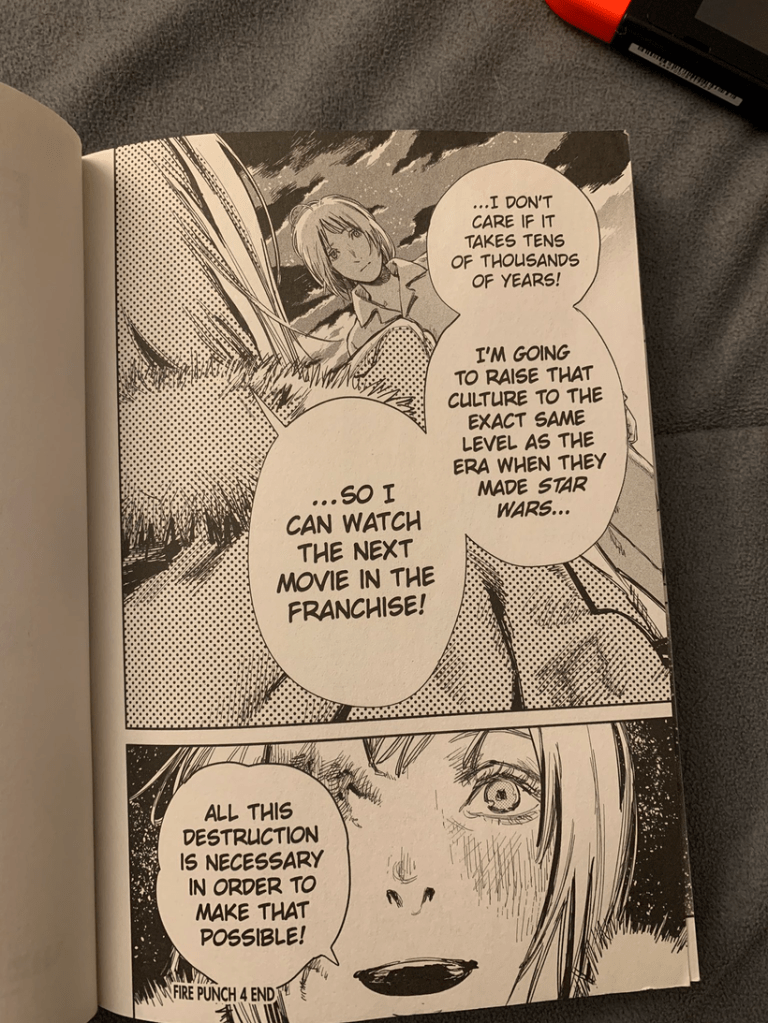
And then comes somebody that claims to be the Ice Witch that supposedly brought the eternal winter, who acquires Judah and forces her into the form of a tree. The tree would suck all life that its roots would touch, and in time, it’d reinject the life back into the planet all Project Gestalt style to restart civilization. Of course, this means killing almost everyone else on the planet. You’d think that this is an insane plan to restart civilization, which it is… but that’s not the “Ice Witch’s” actual goal. No, instead, her plan is to harvest the life of everyone in the planet so that civilization could one day grow to the point that movies are produced again and she could finally watch a new Star Wars movie. It’s the funniest motive for an evil plot I’ve ever seen, but in spirit, she’s essentially a Disney stan that wanted to watch things in a movie theater during lockdown, consequences to anyone else be dammed.
This is not to say that the powers of the blessed can’t be used in a non-abusive way.
After Agni and Luna escape from the guy that kept them prisoner, they happen upon a village. The village welcomes them and protects them and the two help the community in return – even providing their limbs as a food resource, even when some weren’t willing to resort to cannibalism in spite of food scarcity. And years later, Agni would do the same again for people that view him as a god – once again providing food from his body and having his never-ending flames provide heat for people.
The thing is, there’s work to be done in the world of Fire Punch – but that work could be provided in a non-exploitative way. Hell, the “Ice Witch” wanted to bring back movies, but Togata was already doing that in his own way – and while his methods of making a movie weren’t exactly morally sound since he’s the first trans man Joker, it’s still more ethical than “killing everyone on Earth so that you can one day watch a new Star Wars.“
Ultimately, the thing that gives stability to the world is Judah consensually turning herself into a world healing tree without sucking up the life around her, instead branching out into space to heal the planet with nutrients beyond Earth. It’s a method that takes long and isn’t a perfect method to Earth’s fixes, but it’s a plan that’s more considerate to the people of Earth as opposed to the “Ice Witch’s” quicker, short-term profit plan of killing a bunch of people. In other words, it’s a plan that puts sustainability – no matter how impractical – over the capitalist mindset of churning through firewood to get immediate results.
And there’s important work to be done in our world. Important work that won’t burn people up like firewood. A return to normal in our world is completely antithetical to having a healthy world with healthy people. Like, oh boy, time to drive to this thankless job that could have been done at home, pumping easily avoided emissions into an atmosphere that really doesn’t need more of it. Time to break my back so that somebody could get their training weights in the mail. Let’s start hiring minors to exploit instead of paying existing workers more. If we’re going to work, why not do something important like fixing infrastructure? If we’re going to create a surplus of food that becomes food waste, why not provide that food to struggling communities that need it?

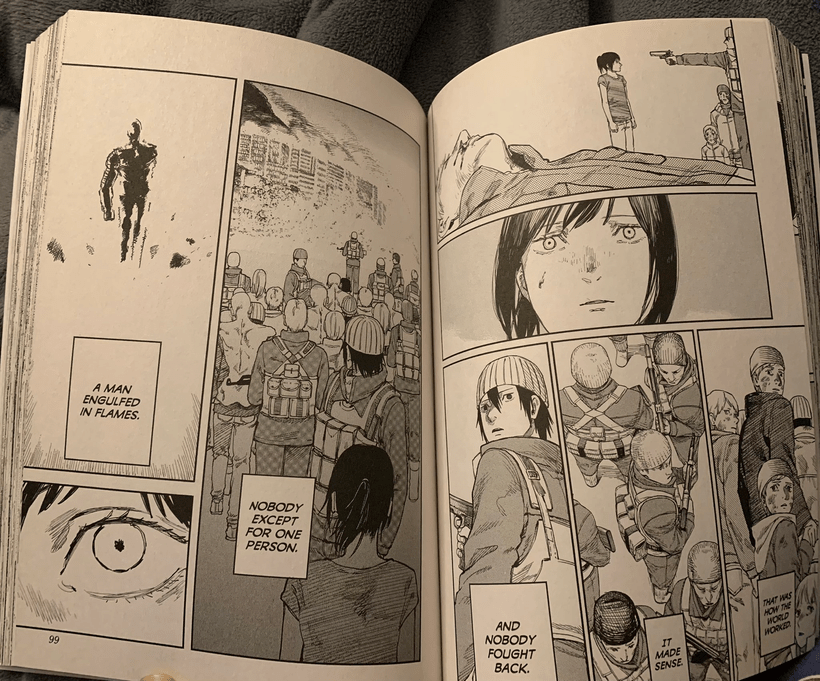
It’s a world full of firewood, but we should be using that firewood to keep each other warm instead of burning everything down, and despite the bleakness of Fire Punch‘s setting, that’s a major takeaway I took away from it.
…But, Fire Punch‘s ideas have echoed onward. This isn’t just me reposting an old work, because now, we’re talking about the future. Let’s talk Chainsaw Man. Full spoilers up to the current chapter.
The world of Chainsaw Man was already a bleak one, where devils powered by humanity’s fears ravage the planet. However, by the end of Part 1, Denji emerged as a new hope as Chainsaw Man, a successor to the devil of the same name that was the Hero of Hell. New troubles show up in the forms of the Horsemen of the Apocalypse (sans Control), with the War Devil possessing co-protagonist Asa Mitaka, the Famine Devil chasing supposedly heroic ends for reasons that rival the Ice Witch’s petty desires, and the Death Devil foretold to come to Earth one day to bring the apocalypse.
However, as Chainsaw Man Part 2 churned on, there’s a conflict going on behind the scenes beyond the potential arrival of the Death Devil: a generational conflict. One where the firewood isn’t essential workers that churn society on, but the younger generations supposedly meant to champion it.

Much like how a cult amassed around the idea of Agni in the latter parts of Fire Punch, a cult amassed around the idea of Chainsaw Man. While the demographics of the Chainsaw Man Church varies, its biggest and most visible demographic are teenagers. These teenagers have a strong distrust for adults, and while nobody truly knows Denji and he himself has no role in things, Chainsaw Man is essentially a teenaged savior figure for these people,
But despite the outward face of the Chainsaw Man Church, the youth don’t have any power in it. Not promotional figure Asa, nor big Chainsaw Man fan and cult promoter Haruka. Definitely not Denji himself, cast against his own movement like Agni himself was in late Fire Punch. In fact, an unnamed old man directs members of the church to fight with weapons that Haruka didn’t even know about.
The one who holds all the actual power is Barem Bridge, the Flamethrower Man working in collaboration with Famine. In running the church, he encourages marriages that are actually contracts that appropriately empowers a Fire Devil, and at his time of need, everyone that formed marriage contracts become horrible Chainsaw Men facsimiles that spread violence that empowers a fear of Chainsaw Man.
In a sense, the youth of the Chainsaw Man Church were just firewood for Barem and the Fire Devil, all for the sake of the kiln cultivating Chainsaw Man’s power so that he could kill the Death Devil. Denji himself is a tool in all this, as it’s not as if he consented or was aware of any of this. In fact, Denji finds his life ruined by the actions of the Church, especially with Barem treating his home as actual firewood, with the Control Devil’s young reincarnation even getting murdered.
But this is not all to say that the government is any better. In some ways, the members of the Chainsaw Man Church are right to distrust adults.
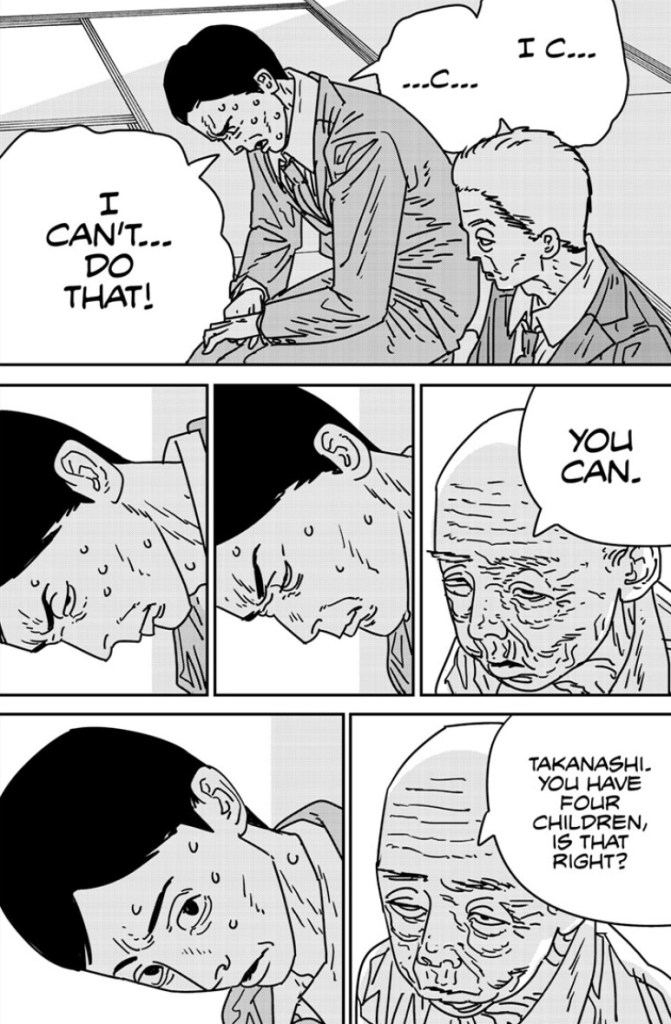
The higher-ups in the Japanese government have a secret plan for the youth in Japan: murdering 10,000 children in front of mirrors as a show for the Aging Devil. In return, the Aging Devil would allow herself to get eaten by the proper Chainsaw Man to erase the concept of aging, which is absolutely just to empower the old fucks in charge of the government. The only one that actively objects to the plan seems to be the youngest man there, but he is cowed to the demands of the oldest man on Earth when he threatens to use his children as part of the sacrifice.
The Death Devil? Not even an active concern. The only member of Public Safety that’s even acknowledged the Death Devil has been its presumably youngest member, Yoshida, and there’s a page that implicitly implies that he’s hamstrung by the older members above him.
The older generations in Chainsaw Man actively use people younger, whether it be as pawns or as mere firewood to kindle contracts. Even before Part 2, the youth in the world of Chainsaw Man were actively used as sacrifices. Santa Claus adopted children to use as sacrifices to send people to Hell, and she raised a disciple just to use as a tool to collect her reward for her and abandon him in Hell afterward. Never mind the general narrative of Part 1 where Makima’s treatment of Denji can easily be read as grooming.
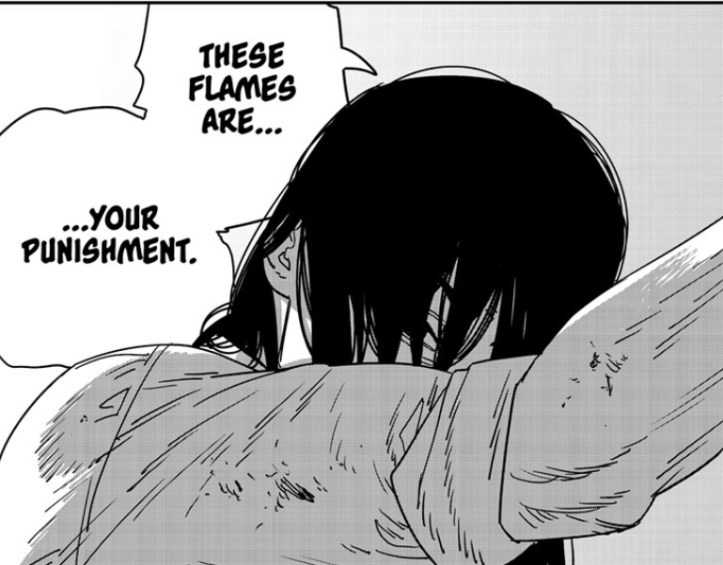
The Aging Devil’s arc feels like the logical endpoint of the general treatment of the young in Chainsaw Man‘s world. The Aging Devil’s the embodiment of the elderly, and their contract seeks to only help the elderly at the expense of thousands of children. If anything, the Aging Devil is excited to watch thousands of children die on the way out. Meanwhile, in the lead-up to the Aging Devil arriving to Earth, the War Devil summons the devils that are essentially her children to repair Asa’s body. Children are just firewood in Chainsaw Man.
It was only timeliness that led me to viewing the blessed of Fire Punch as stand-ins for essential workers, but the treatment of younger generations in Chainsaw Man has a more apparent correlation to real life. Younger generations are said to be the ones that could change the world as we’re growing up, but even into adulthood, most of the people holding actual power are still older people. Young people can vote, but often times the voices of young voters are ignored and some smug liberal bluecheck will go “the youth don’t vote” as if that attitude isn’t a contributing reason for that. Politically, young people are only valued for votes and PR campaigns. Outside of that? Shut up. Young people only exist to prop things up but have no meaningful power themselves.
And oh man, that was just me describing liberals. I’m going to explode if I talk about how conservatives treat children.
In fact, let’s return to my stresses about climate change at the start of this. We were told growing up that we’d be the ones to save the Earth, but again, we don’t have the power to do that. We vote for politicians that supposedly represent our interests, but we have no control over whether or not politicians actually try to follow through with protecting the planet. I remember Greta Thunberg being a valued voice against climate change and being a PR darling, but as she started adopting more serious beliefs to actually act on her values, she was tossed to the side. With regards to climate change, the older people that have much more meaningful influence on the climate are just what the Aging Devil wants to be: somebody watching everyone younger them die as they go out on a happy note. We’re all just firewood so they can die warm and happy.
In a sense, the threat of the Death Devil being ignored by the government is very much like how our governments are ignoring existential threats.
Of course, I say all this as an American (and Miri’s so right about America regardless of the Church’s conspiracy thoeries). Maybe Japan has different values toward children, maybe not. Regardless, Tatsuki Fujimoto’s works really resonate with me and how I personally view society. The bouts of occasional cool weirdness is just a bonus for me.

I can’t wait to see how Chainsaw Man progresses from here. Maybe there’s a bright spot for the youth of Chainsaw Man‘s world, as the titular character actively refuses to participate in the Aging Devil’s and the Japanese government’s plans. And maybe there will be a bright spot for us too. For the workers, for the youth, for everyone.
 Indie Hell Zone
the line i think back to a lot is when the war devil says, “Children are their parents’ property, no?” it remains permanently stuck in my brain. and while it probably had to do with me reading at the same time about how the evangelical right just straight up do view their children as property, it still serves as a chilling line.
LikeLike