
I promised myself that I’d play Ib. I lied.
I cut myself off from Balatro when I reached 50% completion. But the casino called me again. Maybe it’s the Las Vegas blood in me, or the fact that I recently watched the second season of Kaiji. This new game calls to me, and you know, it’s nice to write about new releases every once in a while.
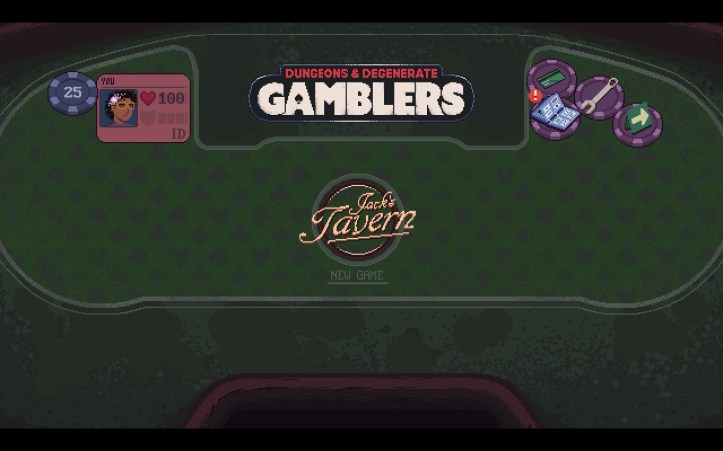
Dungeons & Degenerate Gamblers is the hot new gambling roguelike on the block, by Purple Moss Collectors and published by Yogscast Games. There is a tavern that’s a front for a gambling empire ruining people’s lives, the main fascination being a weird form of blackjack played with custom cards. You set out to confront the overseer of this game… but can you play your way to them, or will you become just another victim of the game?
D&DG is blackjack, and like Balatro, I’m not going to explain how its central card game works like a Youtube essayist. You and the enemy player have health and damage is dealt with the number of the winning hand minus losing hand, so folding on a lower number might be preferable to risking a bust, which is a zero that dooms you to taking full damage. Getting a blackjack grants an additional bonus based on the suit of the card used, like healing or shields, though you won’t get that bonus if you tie – however, since enemies also benefit from blackjacks, aiming for ties is good when you can. Unlike real blackjack, you can check your deck – not the order of cards in the deck (unless you have certain card effects), but you can make a reasonable guess on whether or not to push your luck. You can also check the enemy’s deck to imagine how they’d do on their own draws to better think on what to do. Luck is still a factor, but lifting this veil invites more strategic thinking that I really appreciate.

But it’s not going to be normal blackjack forever. Only the bartender plays things normally, then people start busting out the weirder stuff, progressively getting stranger the further down the gambling rabbit hole you go. The recurring Gambler busts out a card that’s a scratch ticket that adds up to three random numbers to the score. Some time-displaced bard plays a card that’s just the guy from The Witcher to erase one of your cards for the rest of the encounter. The manager of the bar hands you a business card to trade out one of your cards – which he can still do after you stood, letting him lower your score with no way to fight back. However, when your deck reshuffles, you can pull the same shit on him when you draw the business card.
As you can infer, you too can get wacky with cards, as you’re given a choice of cards to add after an encounter like more standard cardbuilder roguelikes and there’s a nice variety of weird cards. The Blood Donor card lowers the value of any hearts cards you draw in the same hand, but it also heals you based off that value. An Ace-Up-Your-Sleeve gives you an emergency Ace on the side to play when the stars align. The Jack-in-the-Box acts as a Jack, but you can close it to set its value to zero if you’re in busting territory. A Communist Party Card forces tying current values – handy if your opponent already stood. At points you can hit up a fortune teller to get tarot cards, like a Wheel of Fortune to grant a random beneficial effect, or an Inverted Sun to borrow one of your enemy’s cards. I personally wish that there were more in-game opportunities to cut cards out of your deck, but overall the card building experience is satisfying, especially since you have a set goal to build toward: getting good at blackjack.
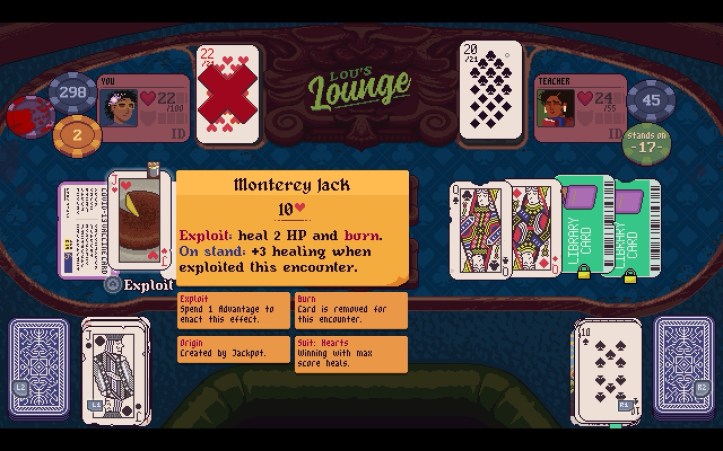
Notably, D&DG isn’t a complete roguelike. While your card selection is random and your after stage choices are random, your opponents are not. Almost all of your opponents use fixed decks themed after them. Alucard’s got that Blood Donor card and the Scratch card from Slay the Spire, trying to keep himself healthy while building up the scratch damage. The Medusa secretary centers burn damage from the Cobra King card that does damage based on how many kings she has and has a Kingmaker to make more kings. The DJ actually copies your own deck as a “remix” and Your Biggest Fan is so parasocial that he also copies you. Because of this, you can try to prepare in advance. Luck is still the name of the game and you still need to work around your own card drops, but these opponents are surmountable.
I think the first real lesson in this is the Bouncer, who always fights with a deck of three cards: two 10s and a 21. Almost guaranteed to win a round unless he draws a 10 then 21. Pure blackjack skills isn’t enough to deal with him, especially since his blackjack gives him shields to sustain himself. Have a Dis-Card to force him to discard one of his cards after he stands for a manageable win, or have a way to force your own cards into his small deck to completely disrupt his flow, or find a way to change his cards. I had a run with the Victim Card, which raises the value of all the cards in an enemy’s winning hand; while taking losses hurt a bit, it became impossible for the bouncer to win a hand afterward since he’d always bust. Go for the throat, anything goes. Plan, prepare when you’re capable, and maybe the game won’t be so cruel to you.
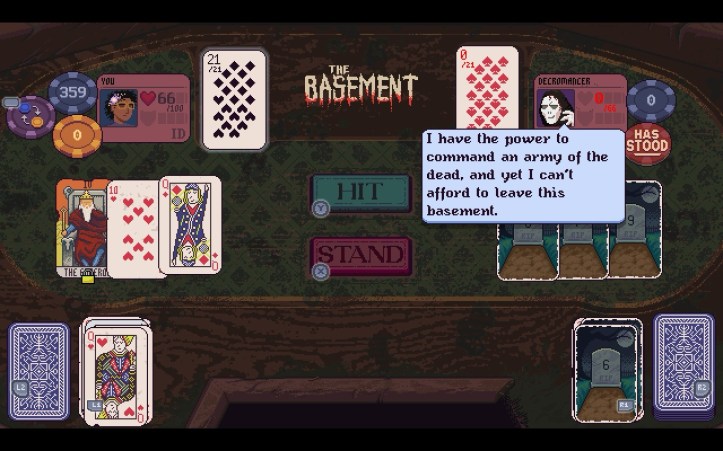
Dungeons & Degenerate Gamblers is a cruel trial, but it knows it portrays something cruel and isn’t judgemental about it. Degenerate is a word that has bad context to it, but as one of the narrations in the first stage puts it, the people of the casino are unfairly labeled that when they’re really victims. The Teacher bemoans her own gambling habits and how it’d affect her family, the Developer is trapped in indentured servitude to the company connected to the gambling den, etc. The recurring Gambler is a tale of addiction, starting out with a normal game but growing more and more haggard every time you encounter him in his desperate attempts to win back face, while openly questioning if you’re any different from him.
Really, two takeaways can be taken from Dungeons & Degenerate Gamblers. One: gambling is fun. But two: it’s a terrible thing if you’re not part of the house. This takes me back to Kaiji. Kaiji is a man that fights like hell to get out of his circumstances through gambling and trying to rig things in his favor. He does get wins, but for one reason or another, he gets called back in. And really, playing this game makes you like Kaiji – everyone is Kaiji, actually. You can’t win through playing blackjack normally, no. Rigging the game in your favor is the name of the game, and if you lose – or even if you’ll win – you’ll come crawling back.
But unlike Kaiji, you won’t be ruining your life playing this game, because it is just a game. The only money you put in is buying the game, and from there you can gamble as you please. Just don’t think about doing real blackjack.
I don’t think Dungeons & Degenerate Gamblers will have the same hold Balatro’s had over the gaming world because it has way more moving parts, but it’s damn good in its own right. If you’re looking for a cardbuilder, if you have the heart of a gambler, consider checking this out.

Now, I said before that I’d treat OTXO as a wildcard and play it for real in the future, so uhhh let’s cross that off. I wanna make some progress on this bingo card, after all. I’m still going to play Ib, and hopefully nothing else will steal my attention.
 Indie Hell Zone
[…] Quibble Racing! You’ve seen me play Balatro and Dungeons & Degenerate Gamblers this year – I fucking love gambling games, man. I vow to never gamble for real and I cut […]
LikeLike