
I haven’t really played anything for Indie Hell Zone, as per what I wrote last time. However! I’ve been casually playing a game over stream with somebody over the past few weeks that’s a perfect fit for this blog. So I thought, “hey, why not write about my thoughts so far?” While I’m falling into the trap of turning my life into Content™, this is content I enjoy.
This write-up is based on my time with the first three chapters of the game, so keep that in mind.
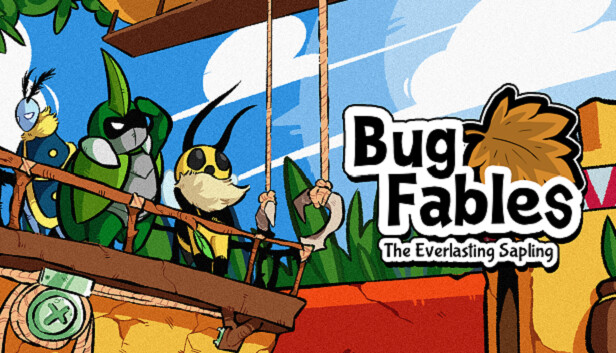
Moonsprout Games swung into the scene with Bug Fables: The Everlasting Sapling. It’s an RPG that’s heavily inspired by Paper Mario that came out in 2019 to wide acclaim. I got this as a Christmas gift from my friend Trick and friend of the site and partner Infomantis encouraged me to finally play it to them and goddamn, I’ve been missing out.
The game takes place in Bugaria, a land (read: backyard) filled with sentient bugs. Queen Elizant II of the ant kingdom is spearheading the quest to search for the titular Everlasting Sapling, which is said to give those that partake of it immortal life. You’re placed behind the control of Team Snakemouth, a ragtag adventuring group consisting of the seasoned explorer beetle Kabbu, the rude rookie bee Vi and the magic wielding, freshly reawakened moth Leif. Together, they go out to advance the search for the Everlasting Sapling whilst grappling with local threats like an invasive wasp kingdom and egomaniacal colleagues.
I normally wouldn’t go too far in comparing games to other, bigger games, but Bug Fables is just so intrinsically tied to Paper Mario. From its papercraft art style to its battle system, it’d be a hard game to not compare to Paper Mario. In fact, to a lot of people, Bug Fables is essentially the closest thing to re-experiencing the first two games. While I think there’s a lot to like about Super Paper Mario, it’s undeniably alienating with its shift to being an action RPG platformer, and while other games forward went back to turn-based combat, they have annoying gimmicks tied to them and those games abandoned the unique mythos and stylings the earlier games established for a really vanilla world.
But Bug Fables? It’s got the style, it’s got the gameplay… but most importantly, it tries to be its own thing and succeeds at that. There are plenty of games out there that emulate their inspirations so closely that you kinda wanna roll your eyes and just check their inspirations instead (looking at you, Evoland 2). But, Bug Fables instead builds off of its inspiration, bringing the spirit of those games to life in a fresh new body.
As opposed to Paper Mario, where Mario is a silent protagonist that bounces off his array of partners that don’t say much beyond quips past their introductory arcs, Bug Fables keeps a solid focus on a central triad. These characters constantly talk, even if you’re not going for flavor text that lets them gossip about the various people and locales they come across, showing a constant strong presence.
Kabbu is a traditional hero who’s a bit of a straight man to the antics of his companions – but he is also a huge nerd and will geek out on his interests when he has the chance. Like, I honestly think he’s an adventurer to emulate the bug sentai thing he loves so much. Vi is a huge hater and is basically Eddy from Ed, Edd n Eddy to me if Eddy had a bigger inferiority complex. I feel that Vi is a character that people would hate because she’s pretty abrasive, but I love haters, so I love her. Meanwhile, Leif is an enigma, both because of his magical abilities that’s unknown to everyone else and because he’s a person out of time. Meanwhile, they’re the middle ground between Kabbu and Vi, keeping to business while sometimes indulging with Vi’s sense of hedonism.
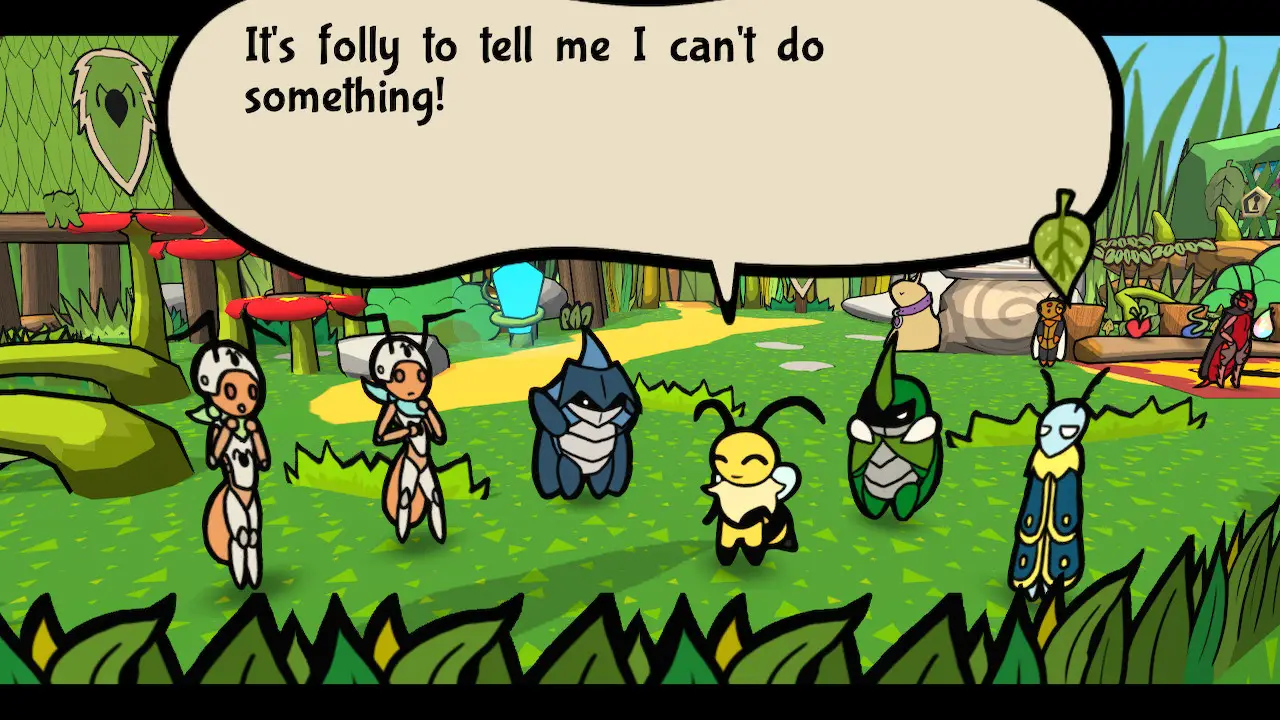
By putting a hard focus on these three characters, Moonsprout Games provides a dynamic playable cast. This is undeniably a field where Bug Fables beats out its inspiration. Even at the point I’m at, there’s still a bunch of stuff going on with the characters. Vi fought against her inferiority complex by proving to her hive that she’s a capable adventurer through resolving a lockdown, but she still has bridges to mend from before she met Kabbu. Meanwhile, Leif has an ongoing sidequest of looking into what happened to the rest of his team after being put to sleep, and the local bee scientist wants to research him to know what his deal is. As for Kabbu, he’s built up an implied history of explorations and has been shown to know a few characters from past escapades, and I’m hoping to see this past paid off.
This focus on a central three carries on into gameplay. In Paper Mario, your team consists of a duo of Mario and a partner character, where the partners all have unique utilities and you have to switch them around in battle and the field. However, with Bug Fables, you’re fighting with all three characters most of the time, and while they have their own niches, they can still learn or gain access to skills that let them diversify. Instead of getting new field abilities via getting new partners, the three just learn to do new skills. Leif’s initial thing is that he can freeze patches of water for various puzzles and freeze enemies to stun them, but he later refines his magic power to create an invulnerable shield, enabling safe travel in the field and defensive options in battle.
So, you may be wondering, how’s the battles like?
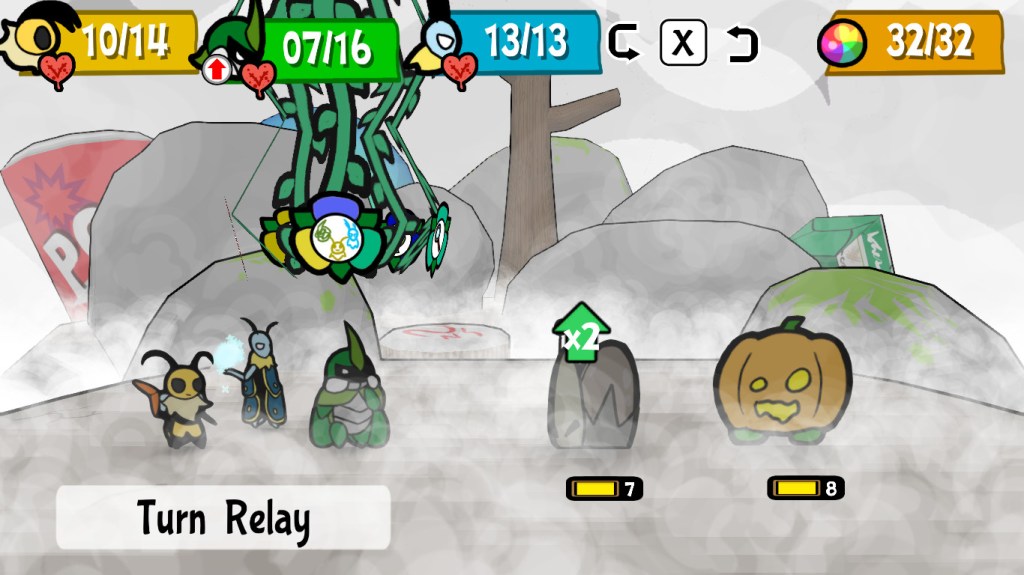
Bug Fables is a turn-based RPG with action commands, those simple minigames where your performance affects how effective an attack is. The last game I played with action commands was Citizens of Space, which I played when I was suffering from vaccine side effects that made doing those commands a pain, exposing an accessibility problem that I never considered before; though I don’t have a lot of good things to say about that game, it does let you turn off action commands (most of them, anyway…). While Bug Fables has you doing action commands, they’re mainly simple ones that don’t put too much stress on your hands; in fact, for the kind that definitely would – button-mashing – the game actually lets you swap that type of minigame for a simpler button pressing one. So hey, thanks for that.
As previously said, you fight with a trio instead of a duo. Before anyone makes a move, you can swap the position of the team around; while whoever’s in front does more damage, they’re also more likely to get targeted by enemies. Everyone in Team Snakemouth has a turn to make a move before the enemy team attacks, where you must time blocks to their attack animations to reduce damage. However, team members can actually pass their turns off to give someone else an extra turn in return for doing less damage
One reason to do this is to take advantage of the unique niches each character has. Kabbu’s normal attack is a flip of his head, which can knock some enemies over or rip off their defenses, though this comes at the expense of only being able to attack the front. Vi’s trusty Beemerang however can hit any enemy, and has the only normal attack that can hit aerial enemies. Leif can hit any enemy on the ground with an ice spike generated from underground, which can also pull out enemies that submerge. Enemy dives into the ground in response to an attack? Give Leif another turn to pull them out. Putting your all into Kabbu’s Heavy Strike and got a real jerk at the front of the enemy formation? Throw your extra turns behind him if you want to blitz an enemy before they can take their turn. There’s this really cool team dynamic between everyone and it makes for an engaging system.
Another neat divergence from Paper Mario is that while those games only had one designated character that gathers information on enemies, the whole team can do that. Further demonstrating the writing of the game, each character has their own takes on every enemy – and the game handily just needs one person to spy on an enemy to give all their hot takes in the game’s menu if you hunger for flavor text. Like with recurring rival colleague Mothiva, Kabbu expresses betrayal in his entry, while Vi goes straight to hating her – and since Leif never knew her like Kabbu does, he’s also a hater.
Why am I focusing on spying? Why, don’t you want to play the local card minigame? Everyone loves card minigames, and Bug Fables’ Spy Cards is a pretty good one.
By spying on an enemy, you also get a card based on them that you can play in Spy Cards. Each deck can have one boss, two minibosses, and twelve regular enemies that you can compile before battles; I wish the game let you make multiple decks, but eh, nobody’s perfect. You can play a hand of cards within the cost limit dictated by the turn against the enemy’s hand and whoever’s hand has more attack hurts the enemy. Cards have various effects, and to take advantage of those effects you can choose to hold cards over to the next turn until you get a hand that you feel is optimal or save stuff like healing cards for when you actually need them.
Spy Cards is a very fun diversion from the main story. After dueling four Spy Cards masters, you can go to the Metal Island side area to participate in a tournament and…
Look, there’s a lot of stuff to do in this game. While the main story is already shaping up to be fairly lengthy, there’s a bunch of side quests and optional bosses around the place. Apparently, I recently unlocked the way toward this game’s version of the Pit of 100 Trials? Fucked up.
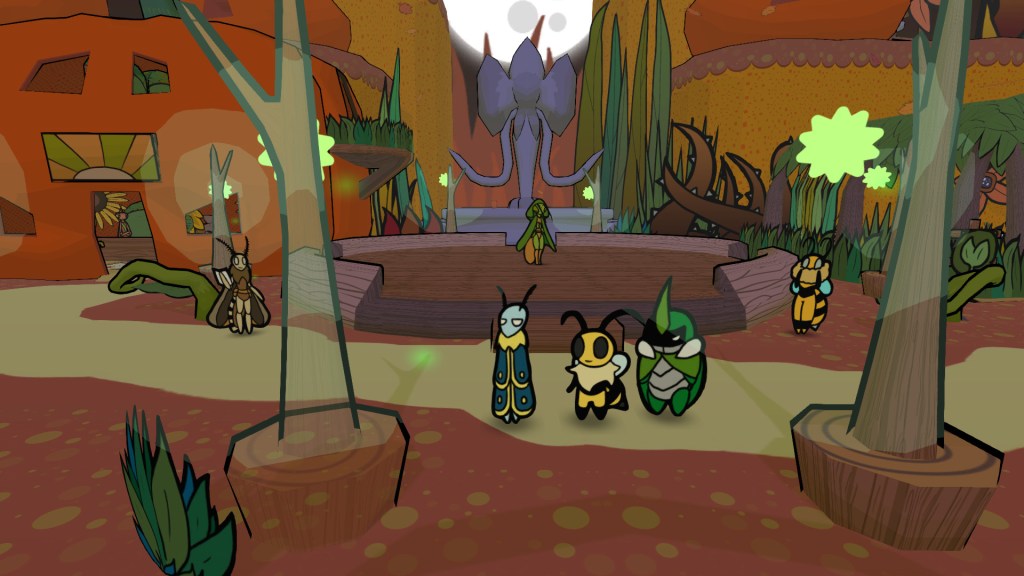
I’m 14 hours into the game and I’m early into chapter 4 out of 7 (and that’s assuming there isn’t a secret 8th one). According to howlongtobeat, 26 hours is the average amount of time it takes to beat the main story, so I still have a long way to go. I don’t know when I’ll finish this game since this is something I’ve been playing casually, but I’m glad to at least get my thoughts out now for the sake of Content ™. Maybe I’ll make another post revisiting my thoughts on the game when I actually do finish it. However, I safely feel that I’ll still be having a good time going forward.
If you want a good RPG to play, this is definitely one to check out. If you’re a Paper Mario fan holding onto insane copium that Nintendo will return to the old days and haven’t played this yet – why haven’t you? In fact, in some ways, Bug Fables surpasses those inspirations.
Definitely far better than Sticker Star, at least.
That game still makes me so mad.
 Indie Hell Zone