
I finished The House of Fata Morgana. However, instead of having one more book club post, I decided to end the book club with a general write-up of the game.
Sure, you’re missing out on the ending, BUT. Consider this your invitation to go pick up the game and play it for yourself. This is one of the best games I’ve played in a long time, and dammit, you WILL play it yourself if you want the last chapter. These ramblings will have spoilers except for the last chapter.
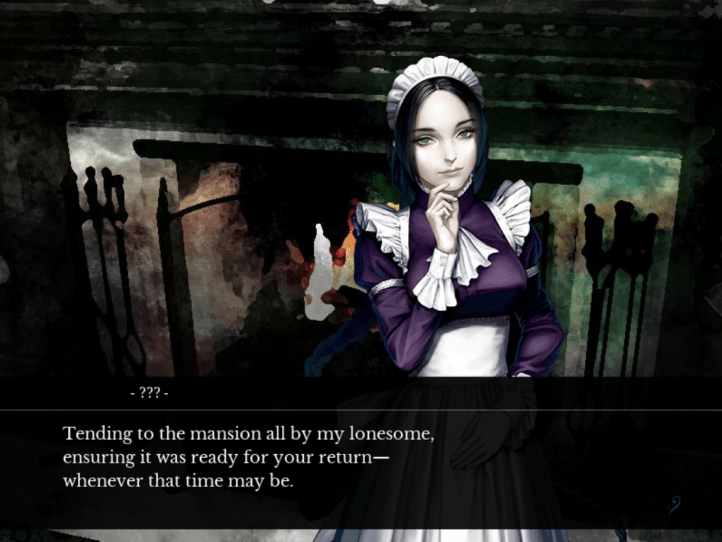
The House in Fata Morgana is the hit visual novel by NOVECT (formerly Novectacle). For a time it was one of the top games on Metacritic which I remembered causing a bunch of discourse. Like oh, sorry it wasn’t a minimum ten year old game like almost everything else on the first page of Metacritic, you goddamn nerds. Bet you’re still complaining about the nearly two decade old IGN review of God Hand. Get over yourselves.
You are someone that wakes up in a mysterious manor that seems to be a place beyond reality. The only presence is a mysterious Maid that feels like a phantom, and her goal is to guide You through the doors of the mansion which shows off the past tragedies of men that once resided in the mansion. You bear witness to these tragedies, and maybe You’ll remember who You are, who this Maid is, and why this mansion is such a wretched place.
Before I talk about how I feel about the overall story of The House in Fata Morgana, I want to talk about the music. The game opens up with a note that the game is best experienced with headphones and… it’s so fucking right. The House in Fata Morgana has one of the best game soundtracks I’ve ever heard. The soundtrack has a strong use of vocals that lends the music an ethereal quality that really helped pull me into the story. The music provides a strong atmosphere and heightens the emotion of a lot of scenes, and I couldn’t help but cry a bit re-listening to some tracks. Listen to it NOW.

I generally liked the art style of the game. I like the character designs of the game, and if there’s one complaint I have, it’s that minor characters don’t get sprites. Now, I totally get it from a practicality standpoint, though it’s weird that Hayden Rhodes doesn’t get one when he has a strong impact on Giselle while Javi from the second door has sprites. Then again, perhaps Javi was some kinda alternative Mell that Morgana wanted to suffer like I theorized…
But yeah, how about those doors?
The first three chapters are seemingly standalone stories of various men that resided in the mansion over the centuries, the only connecting threads seemingly being the mansion itself, its enigmatic maid… and a mysterious White-Haired Girl drawn toward the lives of the men.
The first door is an early 17th century story of a boy named Mell and his sister Nellie and their disconnect as they grew older – especially when a White-Haired Girl entered the picture. The second door tells the 18th century story of a lost Japanese man named Yukimasa that viewed himself and acted as a monster, forgetting about his love Pauline and forming a new connective thread to his version of the White-Haired Girl. The third door explicitly takes the mansion to 19th century America, with a man named Jacopo that saw to the birth of the transcontinental railroad system while grappling with relationship problems with his White-Haired Girl and his friend Maria.
A general read I have with The House in Fata Morgana is that it’s a story that looks at various forms of love – and how it could go wrong.
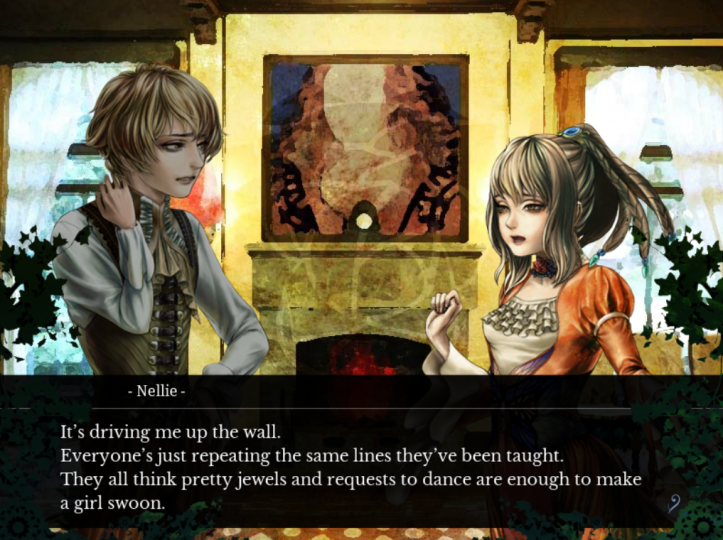


Mell and Nellie have a focus on familial love, and when their chapter starts, they really do love each other. However, their love faded as they grew older – which is a big frustration for Nellie, because her love toward Mell became toxic and incestual. The White-Haired Girl showing up and becoming Mell’s love interest threw a wrench in things. However, Mell wasn’t fully a victim here. Part of why Nellie’s attachment became toxic is that Mell encouraged the growing rift between them and he made no effort to get closer with her in a healthy way. To emphasize this, he wound up alienating his White-Haired Girl through no fault but his own. To maintain relationships, there needs to be healthy communication that needs to be upfront.
Mell is definitely tame compared to Jacopo, though. Christ, this guy. He tried to have a normal relationship with his White-Haired Girl, but when he began to suspect that she’s cheating on him, he isolated her. This is absolutely a chapter of the game that screams “COMMUNICATE WITH YOUR PARTNER” because despite his treatment of the White-Haired Girl and his doubts, he sincerely did want to be with her. Instead of being normal and just talking to her, he got Maria to act as their go-between. Unfortunately, Maria was also his opp, and she took the chance to widen their rift more and more. And like… yeah man, you’re being sabotaged, but really Jacopo, you’re sabotaging yourself by not talking to her your damn self. Maria being your opp was just an incidental wrinkle to all this.
Meanwhile, Yukimasa presents a story of platonic love. He came to care about his version of the White-Haired Girl because of their statuses as minorities, with Yukimasa being a victim of racism and the White-Haired Girl having an unnatural appearance and blindness. He didn’t actually love her, but valued her as a tether to things. Yukimasa reads as an aromantic person to me and is functionally the Joker of aromanticism. Unfortunately, he let the Joker side of him and societal views take over, as he wound up murdering Pauline on account of her being half-Japanese and saw her as a monster like how he and society viewed him. He went all in on being a monster when his actions led to the death of the White-Haired Girl. I guess the lesson here is to work on self-control and to avoid going all in on your worst aspects since it’d get in the way of your relationships? It’s kinda insane, but I respect it.
But contrasting them is a more true love story. And You are the star of that story. No, not you the player, this isn’t some self-insert shit like how some people are somehow still interpreting Deltarune despite the separation between the player and Kris growing more explicit. Rather, You are a man named Michel, who actually has a strong narrative for a player character.

Michel’s love? A woman named Giselle, who actually was the identity of the Maid before being locked into her role. The fourth door shows an idealized version of their past, where Michel was an aloof stranger with magical powers and Giselle was portrayed as the White-Haired Girl running away from people that wanted to burn her as a witch. They fell in love like a perfect fairy tale, but eventually, an angry mob came. Michel died… and the witch Morgana made herself known, promising to reincarnate Michel and the White-Haired Girl.
But Michel realizes that’s bullshit. The fifth chapter happens, showing the true version of events in the fourth door and their context. Michel wasn’t some ideal fairy tale man, but a socially inept guy that’s cold and callous. The White-Haired Girl is stripped away, leaving Giselle, a woman that wasn’t chased away but sent to hide to cover up Michel’s father cheating on his wife; his relationship with Giselle was non-consensual, but with the religious and conservative setting, Giselle would be the only one to face consequences. The nature of the true conditions of the fourth door is important.
Michel and Giselle started hostile toward each other, but in taking the time to learn about each other, they made amends and soon came to be in love. The fourth and fifth chapters provide an important contrast that can be true to life: not all relationships are 100% positive, and there’s hardships that need to be acknowledged. In contrast with the previous relationships, Michel and Giselle actually communicate their issues and become happy. From the perspective of story structure, the fourth and fifth chapters establish the idea that readers should consider that there may be context to why characters act in certain ways.

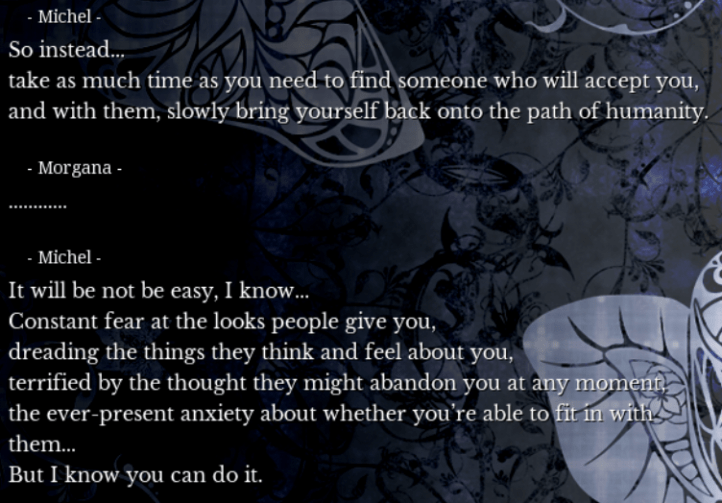
There was one truth that Michel doesn’t share with Giselle when they first came together and it’s the reason for his caginess and mysterious hostility toward certain things, a reason that makes him a target in the eyes of the conservative Christian world that also victimized Giselle: Michel is an intersex trans man. I heard about a trans character being involved with The House of Fata Morgana, but I didn’t know how textual and truly important Michel’s transness is to the story. He was shown as a witch in the falsehood of the fourth door precisely because his real self was seen as just as demonic, even if the truth is far more mundane. Michel did truly die, but his death was a result of violent transphobia and… well, it’s a story that’s especially resonant today with transphobia in government.
Michel’s story is a struggle of finding acceptance and love despite the world in his time and place rejecting him. He finds solidarity in Morgana as she was also a person regarded as inhuman in life, and in trying to give her assurances, he gives her a little speech that simultaneously feels like a metaphor for living as a trans person. With his experiences, Michel melded himself into an empathetic character and he wishes for a happy ending for everyone. Michel’s trans identity is a very important part of the story, and if the upcoming live-action adaptation strips that out to conform to sensibilities, that’d be a goddamn shame.
Oh, right. Morgana. Gotta acknowledge the woman the game’s named after.

Throughout the first half of the game a witch is constantly alluded to, said to be behind the nonsense of the manor. After the true version of Michel and Giselle’s past is revealed, the witch Morgana properly appears, showing that her existence in the fourth door wasn’t exactly a lie. As said before, she finds Michel to be someone in solidarity with, and with his dying request, Morgana attached herself to Giselle. Morgana turned Giselle into an immortal being, the Maid, and while Giselle waits for a reincarnation of Michel to come to her, Morgana had a job for her new Maid in mind: oversee the suffering of the reincarnations of Mell, Yukimasa, and Jacopo.
In a time before Giselle and Michel, Morgana presented herself as an inhuman being that brought blessings. However, it led to her enduring horrible suffering to take advantage of her supposed gifts. She soon died and she became the witch that presumably controls the manor, and she wished to echo her pain onward to future versions of the men that contributed to her agony. As the first three chapters show, she succeeded in giving them bad cursed futures, giving them ironic bad endings. But she wishes to keep doing it over and over and over…
In fully realizing the truth, the spirit of Michel opts to end everyone’s suffering and give Morgana closure. Michel believes that there was context to what led to the men’s betrayal, as Morgana believes that they senselessly tortured her. With the 4th and 5th chapters, it’s a sensible thing to believe, because while Morgana is a powerful being, she isn’t a truly omnipotent one.

It then leads into the biggest chapter of the game, with Michel and Giselle navigating the days right before Morgana’s death and everything going wrong. It’s a mostly good chapter of Michel getting to know the original versions of the men, and while he isn’t all forgiving toward them in spite of his empathy, he does urge them to try to do the right thing. After all, for things to properly end, everyone needs closure.
…And I say mostly because this leads into my big sore spot with The House in Fata Morgana: Jacopo. Setting aside being a dipshit asshole in the third chapter, he’s… honestly a worse person in this later chapter.
The original Jacopo was in love with Morgana… who was underaged at the time! Now, the game doesn’t exactly approve of this, and in fact, other characters kinda regard him as a fucked up loser for it. Now, even if Morgana wasn’t underaged, she was a woman that ended up getting subjected to torture for the sake of his own power. He came to regret it, but the thing is, he only regretted it because said woman was someone he knew before. If he was subjecting the story of the city of Omelas to a complete stranger instead of someone that ended up becoming Odio, he would be completely shameless. He only felt guilt because it hurt him and he faced consequences for it.

Like, yeah, Jacopo felt love for his victim, but that love was rotten and he’s still a terrible fucking guy if circumstances were different. Now, he’s not exactly seen as deserving of forgiveness, he just needs to admit guilt to give everyone a sense of closure. His story ends in a respectable way that doesn’t really excuse him… but goddamn, I hate this guy. I guess in a story all about love, you have to acknowledge that sometimes, the person expressing love fucking sucks.
While I say that, I actually do like the story’s stance on forgiveness. Ultimately, you don’t need to forgive the people that hurt you, even if they’re truly sorry. However, it’s important that they’re sorry at all, and instead of getting revenge… it might be better to move on. Fata Morgana isn’t a story about the cycle of revenge, but a story that just kinda asks… is it worth it? It may be better to find closure and just move on. And really: isn’t learning to let go of hate and moving on a form of love in itself?
It’s a moral I’m trying to take to heart. I finally uninstalled X the Everything App (blaze your glory) from my phone because man, 3/4ths of the site is full of fucked up losers. But instead of sticking around to mope about it or hope the freaks there change (doubt), it’s way easier and freeing to move on.

And now that I’m free of the game, I can walk away saying that The House in Fata Morgana is now one of my favorite games. I love the characters (well, Jacopo’s there I guess), I love the relationship between Michel and Giselle, I love how the story is told and how it expresses its ideas. The music piling on the emotion and bringing a flair to its most dramatic moments is just perfect, and you’re honestly missing out if you play this game without sound. It’s also really cool that the story is uncompromising and honest with its trans character, and it’s important to see that in our current moment in history.
I don’t know when I’ll get around to playing the side games (especially since one of them is about Jacopo….), but I’m definitely looking forward to the promised live-action adaptation and hope it stays faithful in our trying times.
…Eh? What happened to the White-Haired Girl I’ve been mentioning? Is she truly real? Well, I leave that to you playing the game yourself, heh heh.
 Indie Hell Zone
I also finished the game recently and it was amazing. I am so glad you enjoyed your time with Morgana. Sometimes a piece of fiction captures the human experience in a special way, and this was it for me.
LikeLike
Also a hard agree on twitter being an annoying hell hole
LikeLike
[…] particularly anime – and playing this game reminded me of my own path. Earlier this year, we followed the story of a trans man and today, we’re looking at the story of a young trans woman. And uh, this sure is a time in […]
LikeLike
[…] this game I’ve heard about for years. The story is very absorbing, and while I still consider The House in Fata Morgana to be my favorite narrative game I played this year, Pentiment is a strong […]
LikeLike