
(cw: discussion of rape)
I was left rubbing my hands by the end of the chapter. Things are getting exciting, and I was actually right about one of my theories after all.
With the Fourth Door finished, the Maid wants You – presumed to be the White-Haired Girl – to give up on pursuing Michel and just stay in the mansion with her. Multiple choices are actually presented here, and first, I chose for You to run away and abandon the mansion entirely. The vibes are awful, You need to get away, do not fall for creepy maids.

And You actually get away… then suddenly wake up in Paris. You don’t know what You were doing before appearing at the manor, or how You got there, but those questions are put on the backburner when You see Michel. Michel’s in a trance, murmuring about wanting to return to the mansion. Was he in the same situation You were? Well, before You can truly talk to him, he dies in a car crash.
But hold the phone: that alternate ending doesn’t seem real.
In fact: was any of this real?
In the actual canonical route, You realize that You were fed a bunch of horseshit. The Fourth Door actually does contradict the earlier memory seen on the way to the Third Door, and You’ve yet to see a memory witnessed on the way to the Fourth Door in its full context. Despite the Maid insisting that You’ve seen everything the manor has to offer, You know that You’re not getting the full picture. The Maid argues with You…
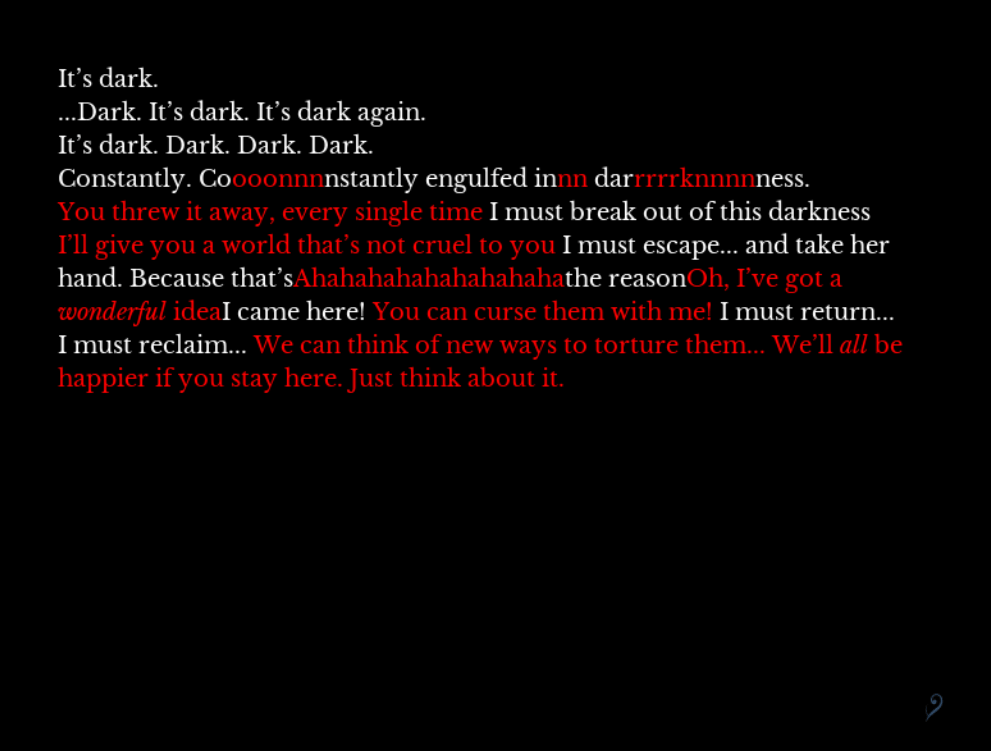

And then the narration itself argues with You. It doesn’t feel like the Maid, but the mansion itself – or maybe the witch, if she’s truly real. You push against the narration to reclaim Yourself and a sense of truth over the narrative, and You finally come to important realizations…
You are not the White-Haired Girl. She isn’t even real.
And so I pumped my fist that one of my predictions was right and that I had also been fooled by the lies of the Fourth Door: You actually are Michel.
The White-Haired Girl? Well at the very least, the one behind the Fourth Door is partially misremembered. She really was a woman named Giselle, but the true Giselle had dark hair – an early version of the Maid.
As it happens, Michel and Giselle actually did reunite, but Giselle not only doesn’t remember, but she actively rejects the truth of her past. Michel rightfully points out that the Fourth Door is too happy compared to the others, just some fake shit that Giselle wants to be reality. And so, instead of Giselle taking Michel’s hand, Michel takes hers so that they could go through a Fifth Door – the true version of the Fourth Door.
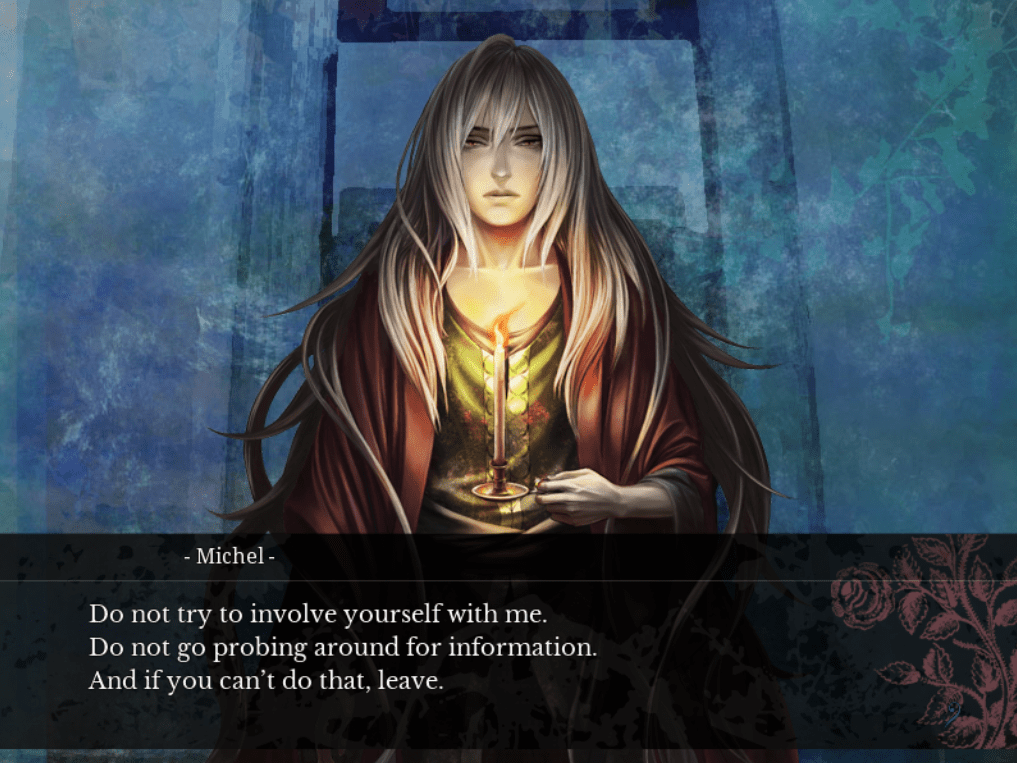
The year is still 1099. It quickly becomes clear that the Fourth Door remixed and edited a bunch of memories. Giselle was not a witch, but a normal looking girl that formerly worked under the Bollinger estate, sent to live in a remote mansion and watch over the cursed isolated son, Michel Bollinger.
And Michel? He actually starts out as a huge asshole. He avoids interacting with Giselle not because he has a cursed touch, but because he wants nothing to do with her at all beyond letting her stay. Giselle’s interactions with Michel’s makes the White-Haired Girl and Yukimasa feel normal, because at least Yukimasa opened his heart to the White-Haired Girl – Michel actively refuses to do so.
In sheer contrast to the ideal of the Fourth Door, Giselle and Michel start out fucking hating each other. You, the player, get a full taste of this as the narration actually switches perspectives between Michel and Giselle often. For Michel, he refuses to interact because he’s suspicious of why Giselle is there, as he’s deeply distrustful of his family, and paralleling Yukimasa’s problems, is scared that she views him as an abomination. I actually have a theory for a specific reason why he fears this view, but more on that later.
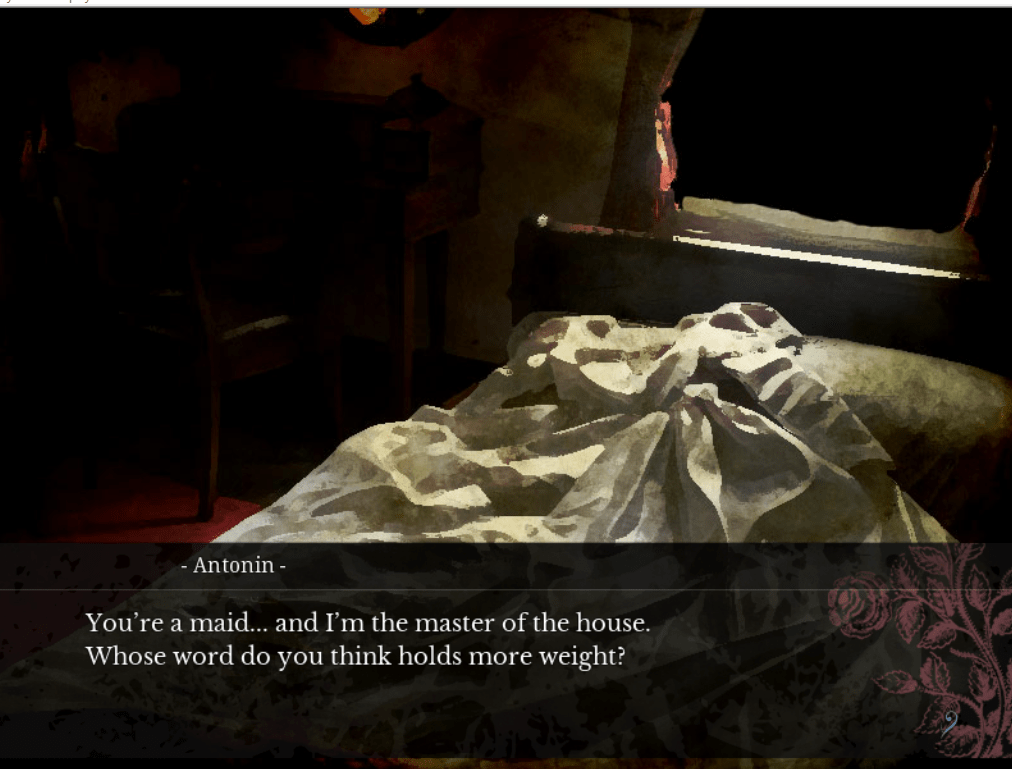
For Giselle, she doesn’t want to get into the full reason why she’s there, and a large part of that relates to trauma. She was a mere merchant brought into the service of the Bollinger family, paralleling the abnormality of the White-Haired Girl becoming a servant in the First Door. However, unlike that White-Haired Girl, there’s no hidden loving reason for Giselle to work under the Bollingers. Michel’s father lusted after Giselle, and he used his position to rape her. He held the position of her family in his hands, and who would people believe: the noble, or the servant girl?
Eventually, in spite of the rape and abuse Giselle endured, the matriarch of the family found out about the affair, and because of the positions and the time period, she branded Giselle as an adulterer. Giselle could have been straight up killed, but she was instead banished to be in isolation. She hoped that she could use the new position as a new beginning for herself, but, unfortunately…
The relationship between Giselle and Michel outright fractures when she goes into his room uninvited and uncovers the ruined portrait of a woman. He had previously shown fear at being sent a picture of a woman with his food supplies, but before she could really dig into it, Michel goes ballistic at Giselle digging into his personal effects, feeling that it validates his fears. With Michel brandishing a knife at her that triggers trauma that his father gave her, Giselle opts to leave the mansion.
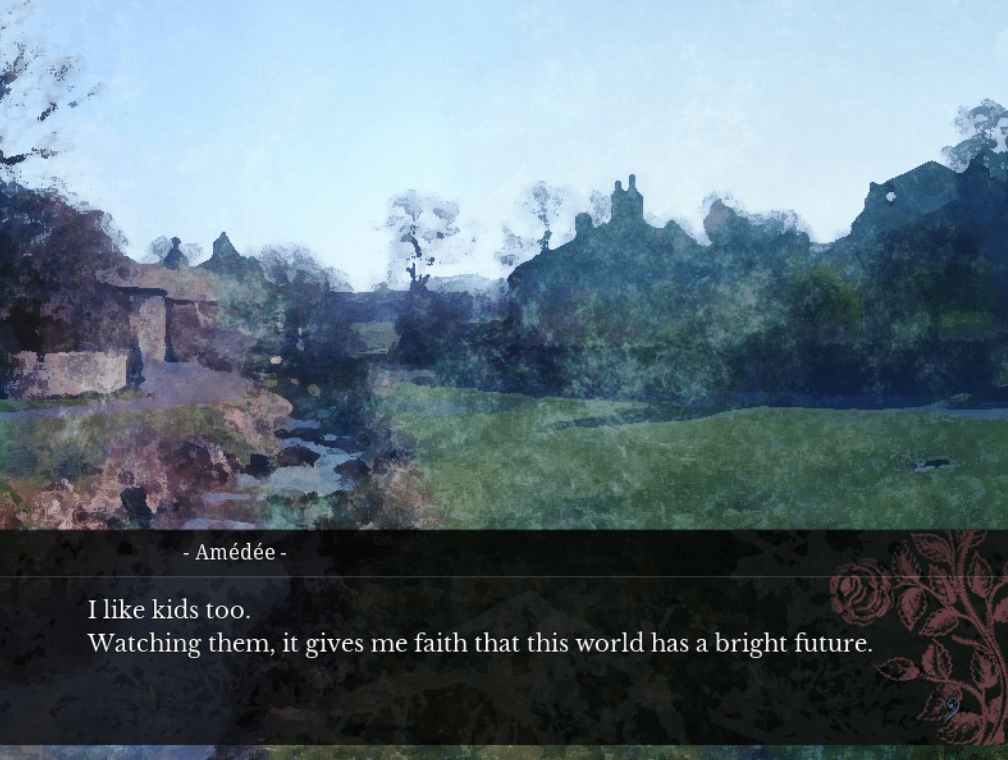
Giselle attempts to just let the elements kill her, but she gets rescued by a man from the nearby village. He introduces her to a new community she desperately needed, comfort and love that she hasn’t had since she started working for the Bollingers. She becomes a member of the village and comes to be happy…
But of course, that needs to be ruined, because so far, no one in this game is allowed to hold onto happiness. The village is essentially an abandoned ruin of a city supposedly destroyed by a witch, left forgotten by society. Unfortunately, a lord discovers the village and annexes it, not only demanding rent, but back pay for daring to exist in peaceful isolation for years. Everyone quickly swings into poverty, and when a theft happens, Giselle is the easy target to blame. After being tortured a bit, she decides on an easy answer: they could rob Michel.
The true version of the thief showing up at the mansion in the last chapter happens: Giselle led a mob to attempt to rob it. However, Michel comes out. Sure, the White-Haired Girl and her unusual appearance was never real, but Michel shared her traits. He threatens a curse on the mob, and while he couldn’t actually do what he did in the last chapter, his appearance and the legends of the manor was enough to terrify the medieval peasants to fuck off. Giselle was ordered to stay behind, though.
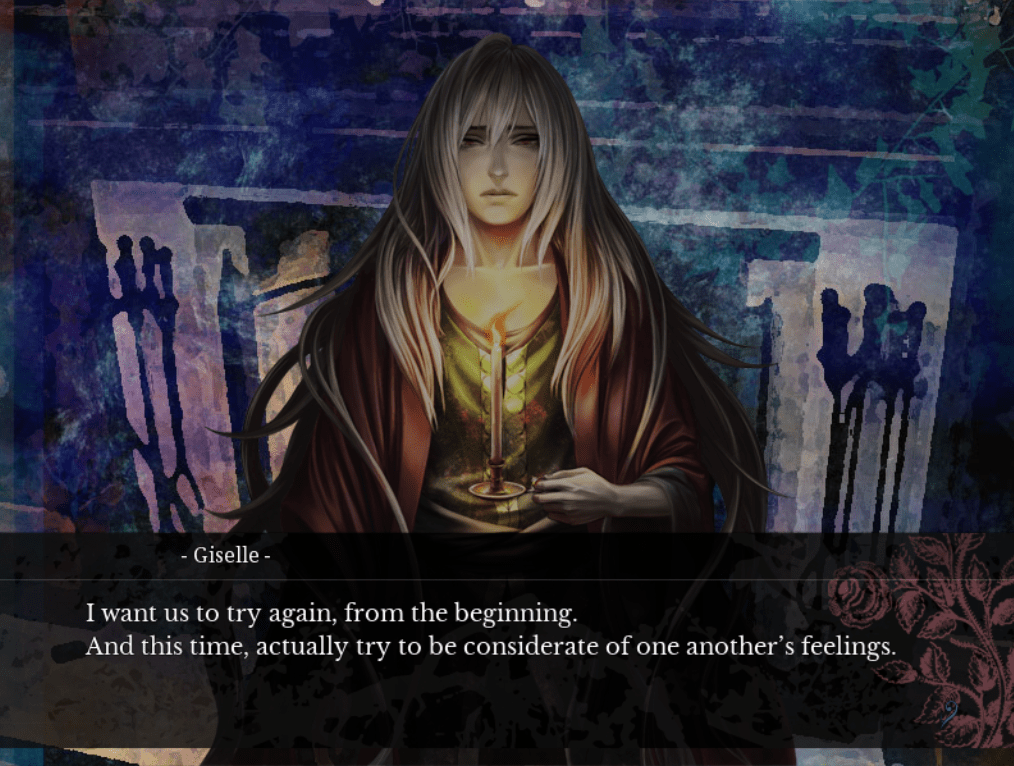
With frustrations fully exercised, with traumas laid bare, the two… actually talk things out. Giselle talks about what Michel’s father did to her and he’s very open to hearing her out and tries to understand her pain. He, in turn, reveals to her that he was actually sent to the manor by his brother – his actual parents straight up wanted him dead and he’s been faking his death, so he was reasonably suspicious to hear about them sending Giselle to live with him. As it happens, it was supposed to be an exile – Michel’s brother was actually the one to give Giselle the addendum to look out for Michel.
And so, with traumas and truths shared, Giselle and Michel decide to start over.
What follows for a while is a romantic comedy. After the pains and dysfunction of the first half of the chapter, Giselle and Michel settle into a nice groove with each other that they had in the Fourth Door, coming to live on equal terms instead of the strained master/servant relationship they had. The Fourth Door pretended that pain doesn’t exist in relationships, while the Fifth Door acknowledges that there can be ugly truths to reconcile with.

Giselle was the first one to grow a rose in the mansion’s garden, and Michel thought it was cool to put it in her hair. He’s totally normal about it. And she’s also totally normal about it.
Eventually, after some romcom drama about totally just wanting to draw the rose and use Giselle as a holder, Giselle straight up tells Michel that she loves him. However… he turns her down. He’s still hung up on the idea of being seen as an abomination from years of being isolated and believes he doesn’t deserve love because of his past.
And the narration mocks him. So, among the problems Michel told Giselle about, he told her that the witch’s spirit haunts the house and she’s been talking to him. She dismissed it as Michel going stir crazy from isolation, but no, it’s definitely real. In fact, that was what was probably standing in the way of present Michel way earlier.
Having successfully been browbeat, Michel goes to Giselle and admits that he also loves her. With this emotional barrier down, Giselle decides to show her naked body to him, and he’s filled with love for her and disgust for the scars that his father gave her. He asks Giselle how she would feel if his father died, but Giselle doesn’t want him dead – not because she cares about him, but because she wants the strength to move past him while he’s still alive and that she could exist beyond the trauma he gave her.
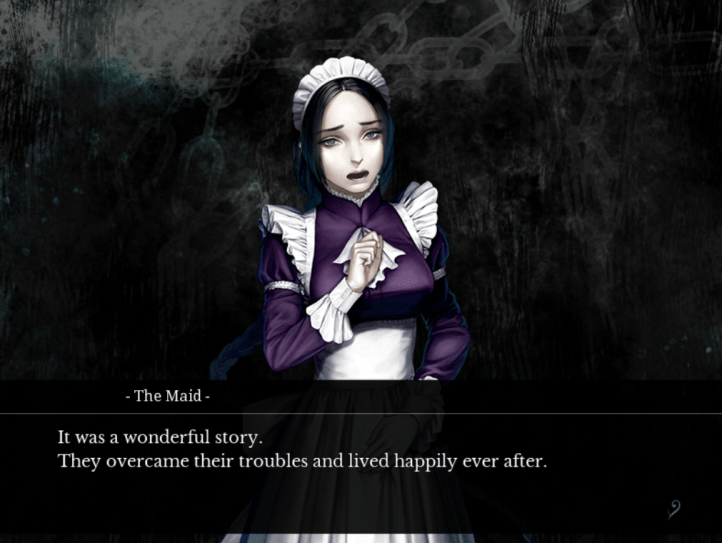
I honestly forgot to take screenshots of when they picked the rose, because I was just too into what was going on. This true version of Giselle’s got a lot going on with her, so it was just really nice to see her finding happiness with Michel. The false version of Michel was mysterious, but he’s actually an antisocial dork, so it was fun seeing him grow close to Giselle and embrace her as his love.
But as I said: no one in this game is allowed to hold onto happiness.
After about a year of living together, they get good news: Michel’s father is dead. Michel’s brother would take over the estate, which would enable Michel to stop pretending to be dead and leave exile. Michel writes letters to his brother and his mother and joins with Giselle in anticipating the future, pondering if she could live in his house without the memories of his father to sully it…

Then an angry mob shows up – tragically the end of the last chapter was real, it’s just the context that was different. It seems that despite his brother taking power, his mother still has power to exercise and she very much wants him dead now that she knows he’s alive. Religious dogma still rules in spite of everything, so the mob’s there to capture Michel as an abomination and crucify him.
Michel leaves Giselle in the tower and offers himself to the crowd. They brutalize him, and unlike the fantasy of the last door, his blood doesn’t poison them. And so, he’s dragged off while Giselle’s left despairing. Michel told her to rely on the witch, yet she does not hear her…
And with the truths of their origins fully revealed – for the most part – the chapter ends. Immediately after the end they go through a Sixth Door, because after all, there’s definitely more mysteries to dig into. And hey, there’s a still that witch somewhere…

Now, let me expand on a theory. Before, me saying that Michel was a transgender man was speculation empowered by pre-existing knowledge. Now though? I feel confident. One of Michel’s hang-ups is with identity, and his fear of being seen as an abomination is an extension of that. That portrait he destroyed and the fears of being sent portraits of a woman? They’re depictions of his old identity, probably. Furthermore, one of Giselle’s flashbacks alludes to a Bollinger daughter – but a daughter is never mentioned outside of the mother, the mother that considers Michel as a curse – in his words anyway. The man that usually delivers things to Michel asks if it’s true that he doesn’t have a “something”, and when the mob’s ready to get Michel, he asks if they’re there for a Michel Bollinger or… something else. I know for sure that he was going to refer to his deadname there if he wasn’t interrupted. I was definitely wrong about Michel being Morgana since she’s a distinct figure from him and he’s not the White-Haired Girl, but I for sure think he’s trans.
I will say: it certainly makes “Reclaim yourself” take on a new meaning.
Speaking of the White-Haired Girl, the reveal leaves a lot of questions for the past chapters so far. Was there ever a real White-Haired Girl, were they all just Giselle misremembering who she was across history? Were the other guys in other chapters different variations of Michel after all, since Giselle was being a bit of an unreliable narrator as the Maid? Were the past memories real, or were they also partially fabricated like the Fourth Door?
Regardless, I’m excited where the Sixth Door is taking us, because I honestly have no clue where we go from here.
 Indie Hell Zone