
Sorry for being a bit late, but let’s start this year off with the next part of The House in Fata Morgana. And boy, let me tell you: I am not sure where this story is going, because I’ve consistently been proven wrong.

Initially, You have a little freedom to explore the mansion. You find a spirit tied to a portrait, who wishes to find the spirit of a man he once painted to apologize. The man speculates that You are unrelated to the tragedies told by the doors so far, but you’re nonetheless related to the manor, which tends to summon people related to its history. He gives You a key to help facilitate Your exploration of the manor. You see vague flashes of memories within, like Melle and Nellie in the garden and the Bestia in the cellar, along with a memory of something yet to be seen.
The Maid reunites with You, explaining that the mansion is a place that’s a bit unstuck from time and place, facilitating Your wanderings for the truth. She guides you up the manor’s observance tower, which holds the door that she believes will be a big step forward.
And so, You look enter the fourth door.
The year is 1099. The House n Fata Morgana continues to be an anomaly to me, considering that it was in America last chapter – it truly must be unstuck in time and place. Looking the year up, the year is notable for being the last year of the First Crusade. Maybe this isn’t a direct part of the First Crusade, but it’s something that sticks to the attitude of the Crusade: a White-Haired Girl flees a village, being hunted down for looking like a witch. While the White-Haired Girl was judged for her appearance in Yukimasa’s time and was only directly victimized because of her proximity to Yukimasa, the White-Haired Girl of this era is actively hunted.
But there’s something unusual that quickly becomes apparent: most of this chapter is seen through a first-person view, and the narration at the start is written in first-person. You are more directly thrown behind the eyes of the White-Haired Girl as the perspective character. Furthermore, the struggles and backstory of the White-Haired Girl is readily apparent. Rather, instead of a guy learning about their era’s White-Haired Girl, the White-Haired Girl is learning about a guy.

She comes across the manor to seek refuge in, and she meets the master of the house: Michel. There are a few differences in specific details from the look from the mirror, like the witch that supposedly cursed the house not being directly named, but otherwise, this chapter is an expansion of the tale told behind the mansion’s mirror. Further tying everything together, the White-Haired Girl – or at least, this variation of her – finally names herself: Giselle.
So, unless there’s some weird timey-wimey nonsense or if the mansion’s recollections are capable of lying, Michel is unrelated to the White-Haired Girl. I’m curious about why the game’s interface sticks to calling her the White-Haired Girl when she names herself Giselle, but for the sake of practicality, I’m writing out Giselle for the rest of the game unless prompted otherwise, because I’m tired of writing out White-Haired Girl.
Now stepping beyond the brief glance in the mirror, Michel steadily reveals the nature of the witch’s curse that afflicts him: anything that touches him fucking dies. As such, Michel isolated himself in the House of Fata Morgana because the stigma against it guarantees that most people stay away from him. He desperately wants Giselle to leave to guarantee her safety, but because the surrounding world is so cruel to her, she’s willing to stay in isolation with him, because as dangerous as he could be, he is the only one that doesn’t want to kill her.
Besides the presentation of the chapter, this chapter has a strong contrast with the others regarding its depiction of love. Mell and his Giselle seemed like they could have had something, but Mell alienates her. Yukimasa initially appears to at least have a platonic relationship with his version of Giselle, but he ultimately values the normalcy she provided him and the joy of murder more than her. And of course, while Jacopo did love his version of Giselle, he has major communication problems that destroy everything.

But Michel and his Giselle are normal and healthy, or at least, as healthy as possible. Michel initially isolates himself from Giselle, but comes to hang around her at a distance. Giselle was illiterate because of her life circumstances, so they started to read together. Michel lives in darkness and has to rely on candles like the dril tweet because his version of the manor has almost all its windows sealed shut, but Giselle relates to that because she has the same aversion to light as other variants of her. In Michel’s self-imposed exile and Giselle’s seclusion, they relate to each other and come to care for each other. They cannot touch each other, but they communicate their problems and feelings with each other. They yearn for the day that they may one day touch each other without risking Giselle’s life.
These two? I think they’re cute. I wish the best for them.
Alas, that’s not to be.
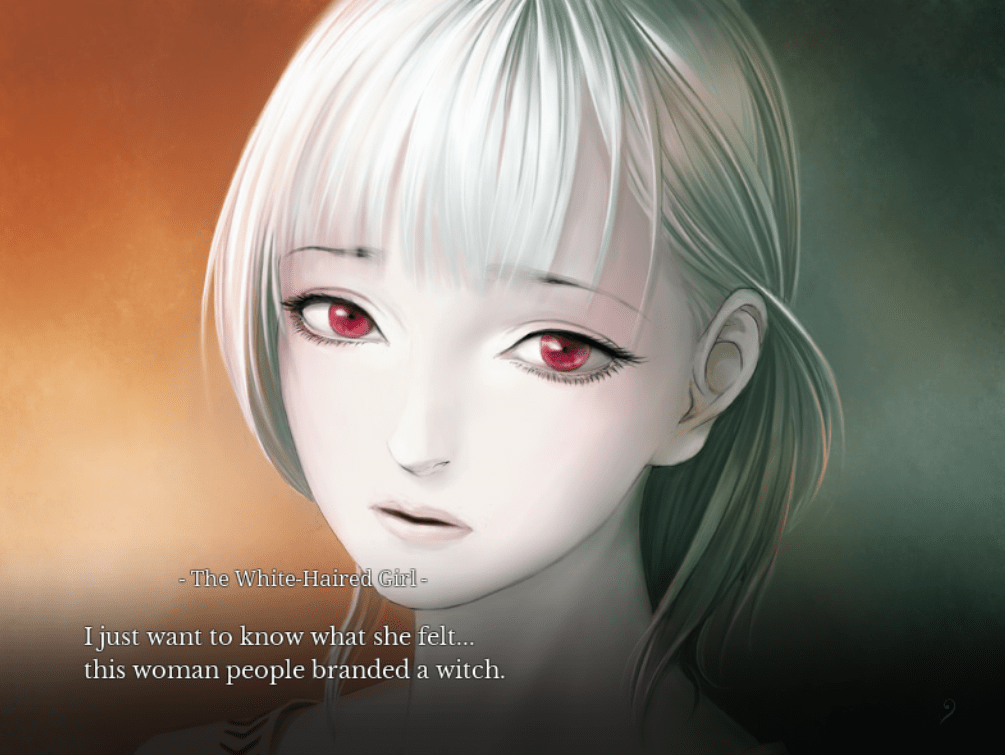
Giselle also finds herself relating to someone else: the witch. Of course, in being accused of being a witch, she’d be sympathetic to an actual witch that was supposedly burned at the stake. She also believed that the witch herself was lonely, being feared for her power besides those that’d risk taking a wish from the witch – even if it comes with monkey’s paw shit. The manor is also where the witch also supposedly once lived, the reason for the status of the manor under Michel’s watch. Giselle, Michel and the supposed witch find safety in the isolation that the manor provides. They’re all the Michael Jordan of Drunk Driving. Well, more like the Michel Jordan of Drunk Driving.
But anyway, yeah, the happiness that Giselle and Michel wished for is not meant to be.
One day, someone shows up to the manor, believing that the witch is there and wanting a wish to be granted. Unlike the Bestia’s visitor, this one proves to actually be a threat and attacks Giselle. Michel shows up to protect her and grabs the man, inflicting his curse on him. Unfortunately, the intruder stabs Michel and Michel’s blood gets on Giselle, leading to her health failing. In contrast to the past men of the chapters, Michel does not hurt his version of Giselle; the pain he inflicts on her here is nondirect, a genuine accident. Unlike Yukimasa, who would have murdered the shit out of the intruder, Michel let the intruder leave, but in a dying state. Unfortunately, the intruder lives long enough to reach a village and alerts people of the woman that looks like a witch and a man with powers like a witch.
An angry mob shows up, pounding down the manor’s doors. Michel and Giselle retreat up the manor’s observation tower, the only place with a proper window and the place they once mused the witch was hidden. Faced with the threat of dying anyway, Giselle has one last wish for Michel: a proper hug.
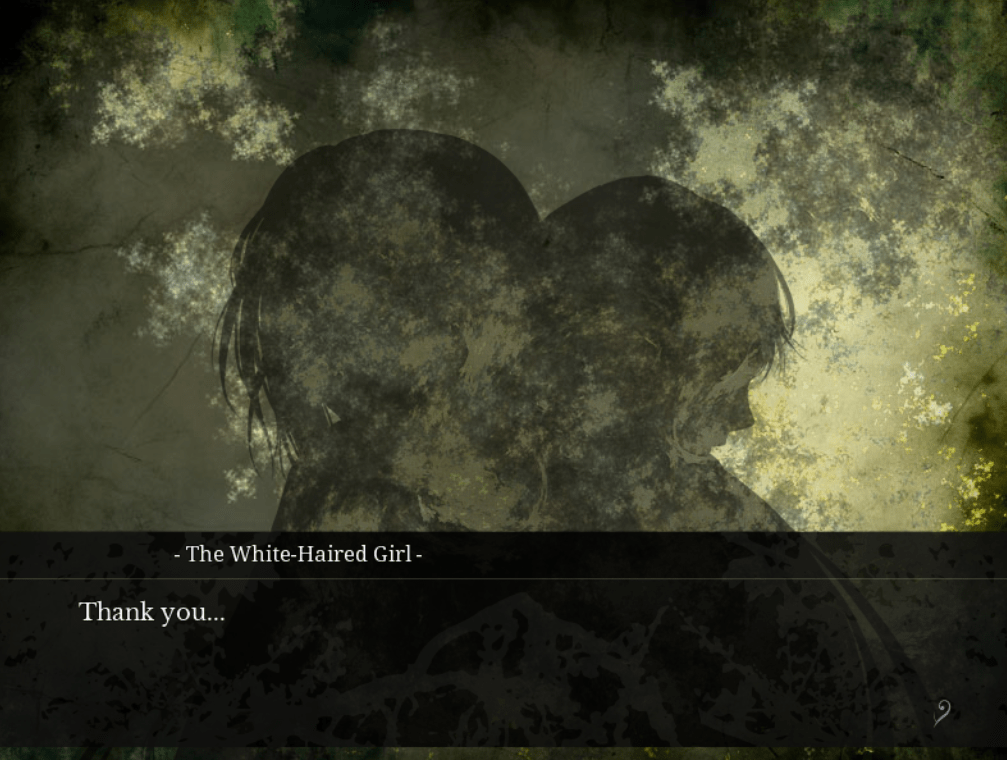
This is the strongest moment in The House in Fata Morgana for me so far. I’ve generally felt for Giselle because all the versions of her so far suffered from poor health, and well, I’ve really been going through it with multiple sclerosis. So, seeing this sad woman receive the love she so wanted as her last moment? That’s cinema.
Believing Giselle dead, Michel goes out to confront the angry crowd that stormed up the tower. He gets stabbed – but that’s no issue for him, because it leads to his blood raining down on them. Essentially placing a dying curse on them, Michel drags his killers down with him. This? This is also cinema.
And then Giselle wakes up.
Giselle discovers that Michel’s last hug really ended up just being that – a hug. She goes out and sees that Michel is dying in a sea of bodies, with no way to save him.
Or at least, this version of him.

Giselle is approached by someone: Morgana, the witch. Or, at least that’s claimed; like Giselle herself, Morgana’s solely an off-screen presence normally. At the very least, this also debunks the idea of Michel being a post-transition Morgana, unless Morgana was some spirit tied to him.
And so, Morgana has something to offer Giselle: a wish to one day find happiness in a different form. Giselle and Michel are to reincarnate. They will reincarnate over and over, being drawn to the House in Fata Morgana again and again. Eventually, some versions of them will find happiness together. But well, as you’ve seen from the past doors, these efforts also have the witch’s curse with how Giselle keeps getting screwed over.
You exit the door. Or rather, Giselle exits the door.
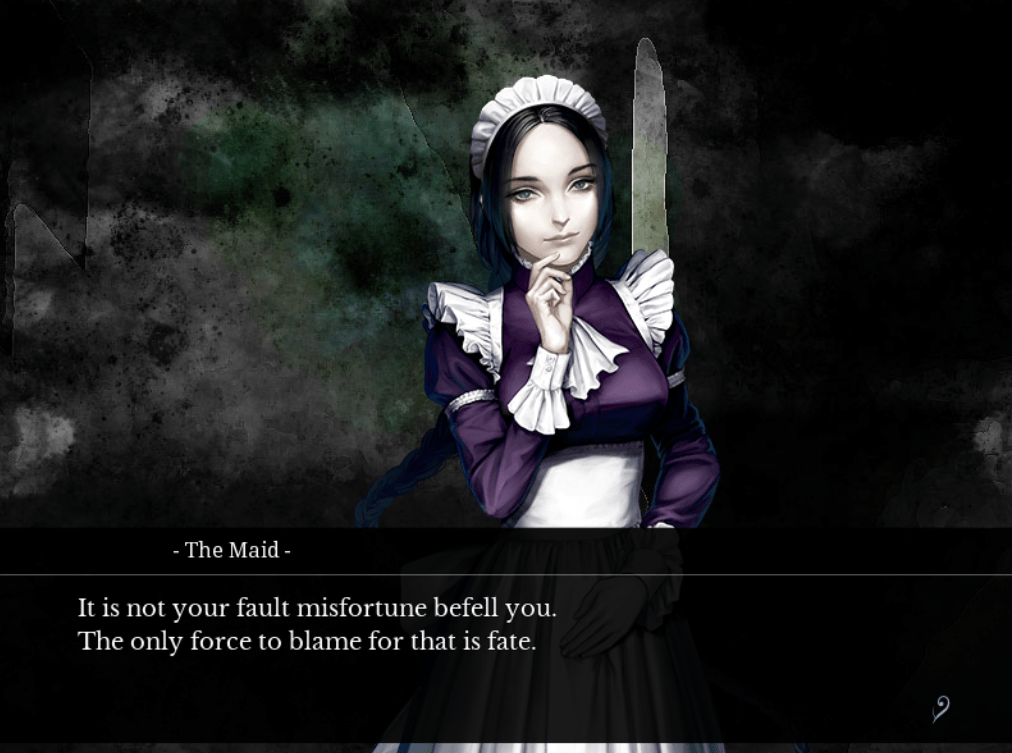
In one final kick to my attempts at theorizing, You are not Michel – You are Giselle. Was that guy in the painting wrong? Or is the Maid lying about who You are? Well, until more information comes out, I’ll stick to calling the version of You that hangs around the Maid You.
You’ve been bearing witness to Your past failures at attaining happiness. At the very least though, the men that other Giselles have gotten involved with aren’t Michels. You are still trying to find Michel within Morgana’s cursed manor.
…But how can You find him?
And so, that’s where this chapter of The House in Fata Morgana.
It feels like this chapter was a big turn in the game’s story that’s left me wondering about a lot of things. The White-Haired Girl might have had her name censored in the past to hide the fact that she’s been going under different names and to assure the player that every variant of her is the same person. Maria discovering familiar handwriting in the last chapter also indicates that more than Michel and Giselle are going through a reincarnation cycle. But also, it makes me wonder, what did Maria wish for to be cursed into this cycle? Are past characters we’ve seen also cursed to be part of the cycle, or are they just normal people caught up in everything?
Regardless, I don’t know what theories I can offer with how thoroughly I’ve been owned. I’ll just keep on going through the manor and see where it takes me.
 Indie Hell Zone
Refraining from commenting to much because I know the whole story but I’ve really been enjoying these check ins!
LikeLike